TaoMetrix: Edge AI Camera OEM/ODM Production Is Not Just About Algorithms and Pixels


An Edge AI camera OEM project requires more than combining a high-resolution sensor with an AI model. A production-ready device must coordinate optics, image sensors, processors, memory, power, thermal design, connectivity, firmware, cybersecurity, mechanics, testing, certification and manufacturing.
The right Edge AI camera OEM partner should be able to turn a defined product design into consistent production. If a brand still needs platform selection, hardware adaptation or joint engineering, an Edge AI camera ODM or JDM approach may be more suitable.
Quick Answer: What Should Brands Check Before Edge AI Camera OEM Production?
Before approving production, confirm these ten areas:
Use case, environment and measurable AI task
Sensor, lens, field of view and lighting requirements
Processor performance, memory and model compatibility
End-to-end latency, accuracy and failure behavior
Thermal performance and power consumption
Network, storage, privacy and cybersecurity architecture
Enclosure, mounting, sealing and serviceability
Firmware updates, device management and production provisioning
Reliability, compliance and production test coverage
BOM control, component availability, pilot yield and change management
The camera should not move into mass production until each applicable item has a written acceptance criterion and supporting test evidence.
Edge AI Camera OEM vs ODM: What Is the Difference?
| Model | Brand provides | Manufacturing partner provides | Best fit |
|---|---|---|---|
| OEM | Mature specifications and production files | Sourcing, PCBA, assembly, testing and delivery | Production-ready custom designs |
| ODM | Product brief and customization requirements | Existing platform, engineering adaptation and production | Faster launch from a proven camera platform |
| JDM | Product vision, AI software and shared requirements | Joint hardware, mechanical and production engineering | Differentiated products requiring co-development |
These terms are used differently across suppliers. Contracts should define design ownership, firmware and source-code access, tooling rights, certification ownership, cloud responsibility, exclusivity and change control.
1. Define the Real Use Case First
An Edge AI camera should begin with the decision it must make—not a megapixel number.
Define:
Detection, classification, tracking, counting or inspection task
Target objects, minimum object size and expected distance
Indoor, outdoor, mobile, industrial or consumer environment
Lighting variation, low-light, backlight or infrared requirements
Required accuracy, false-positive and false-negative limits
Maximum end-to-end latency
Continuous, event-based or low-power operation
Local storage, cloud connection and offline behavior
Installation, maintenance and product lifetime
An industrial inspection camera may prioritize controlled lighting, optics stability and repeatable detection. A security camera may prioritize night vision, wide coverage, weather resistance and 24/7 operation. A retail device may prioritize privacy, counting accuracy and remote management.
Without a defined operating envelope, hardware and AI results cannot be evaluated objectively.
2. Design the Complete Imaging System
Image quality depends on the whole optical chain:
| Element | Questions to validate |
|---|---|
| Image sensor | Resolution, pixel size, dynamic range, sensitivity, frame rate, shutter type |
| Lens | Focal length, field of view, aperture, distortion, focus and temperature stability |
| Lighting | Visible, infrared, structured or application-specific illumination |
| Filters | IR-cut behavior, spectral requirements and day/night switching |
| ISP | Exposure, white balance, noise reduction, HDR and color processing |
| Mechanics | Lens alignment, sensor flatness, focus retention and contamination control |
More pixels can increase bandwidth, memory use, heat and inference cost without improving AI performance. Test the actual sensor, lens, ISP settings and AI model together under real environmental conditions.
3. Select the Edge AI Computing Platform
The processor determines which models can run, at what speed and power level. Compare platforms using the intended workload rather than TOPS alone.
Evaluate:
Supported AI frameworks and model-conversion tools
Operator compatibility and quantization behavior
CPU, GPU, NPU and ISP resource sharing
Memory capacity and bandwidth
Multiple-camera support and interface requirements
Boot time and real-time performance
Secure boot, encryption and hardware security features
Software lifecycle and long-term availability
SDK quality, documentation and debugging tools
Benchmark the production model with production-intent firmware. Record accuracy changes introduced by resizing, compression, quantization or hardware-specific optimization.
4. Validate AI Performance as a System
AI validation should include more than a laboratory accuracy score. Define representative datasets and operational scenarios covering lighting, distance, angle, motion, obstruction, weather, background variation and edge cases.
Measure:
Precision, recall or task-specific quality metrics
False positives and false negatives
Inference and end-to-end latency
Frame drops and sustained throughput
Model loading and recovery behavior
Performance after firmware or model updates
Behavior when confidence is low or inputs are invalid
Document dataset scope, model version, thresholds, firmware version and test conditions. NIST’s AI Risk Management Framework provides a useful general reference for managing AI risks and reliability, although the applicable validation plan must be tailored to the product.
5. Engineer Power and Thermal Performance
Edge inference, image processing, wireless transmission and storage can create continuous heat. Thermal throttling may reduce frame rate or inference speed, while excessive enclosure temperature can affect reliability and safety.
Test:
Power by boot, idle, inference, recording and transmission mode
Peak and sustained processor temperature
Performance at minimum and maximum ambient temperature
Thermal throttling and recovery
Heat transfer through the PCB, heat spreader, enclosure and mounting surface
Dust, sealing and sunlight effects
Power-supply margin and surge behavior
Use production-intent enclosure materials and interfaces for thermal validation. A bench test with an open PCB does not represent a sealed camera.
6. Plan Connectivity, Storage and Cybersecurity
An Edge AI camera may use Ethernet, PoE, Wi-Fi, cellular, Bluetooth, USB or industrial interfaces. Define network loss, reconnection, bandwidth, buffering and offline behavior.
Also clarify:
Where video, metadata and logs are stored
Which data leaves the device
Encryption in transit and at rest
Device identity, credentials and certificate provisioning
User roles and access control
Secure boot and signed OTA updates
Vulnerability reporting and patch responsibility
Factory reset and end-of-life support
Integration with customer platforms or common protocols
Cybersecurity cannot be added only after hardware release. Production provisioning, unique credentials and update recovery must be included in factory processes.
7. Validate Enclosure and Installation
Mechanical design affects image quality, heat, wireless performance and reliability. Check:
Lens and sensor alignment
Mounting rigidity and vibration
Cable exits and connector strain relief
Gaskets, vents and acoustic membranes where applicable
Condensation, dust and water paths
IR reflection from covers or windows
Sunlight, corrosion and UV exposure
Installation access and field service
Tamper resistance and cosmetic standards
If an IP rating is claimed, test the final production-intent assembly. IEC 60529 defines enclosure protection against dust and liquids; see the IEC explanation of IP ratings.
8. Build a Complete Test and Compliance Plan
Testing should cover hardware, software, AI and production variation.
Typical areas include:
Image quality and focus
AI task performance
Long-duration operation and memory stability
Temperature, humidity, vibration and drop
ESD, EMC and power disturbances
Network interruption and recovery
Storage endurance and file integrity
OTA update, rollback and recovery
Seal integrity and ingress protection
Factory calibration and functional test
Compliance depends on configuration and target markets. Wireless products may require applicable radio authorization; the FCC states that relevant RF devices require authorization before marketing or importation in the United States. Review the FCC Equipment Authorization program and confirm requirements with qualified laboratories.
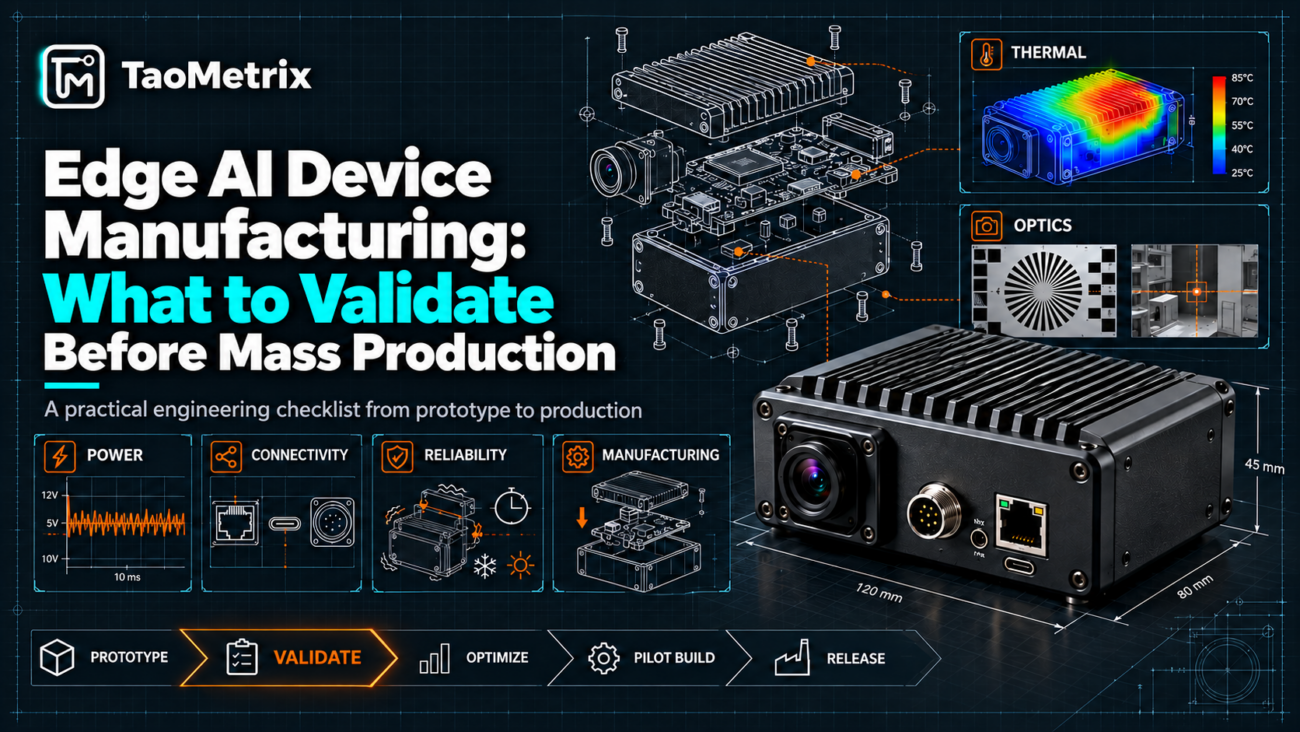
9. Move From Prototype to Production in Stages
Use controlled development gates:
Proof of concept: Prove imaging and AI feasibility.
EVT: Validate architecture, electronics, optics, power, thermal design and core firmware.
DVT: Validate near-final mechanics, reliability, AI performance and compliance readiness.
PVT: Validate tooling, assembly, provisioning, calibration, fixtures and production tests.
Pilot production: Measure yield, defects, cycle time, rework and outgoing quality before scaling.
For more detail, read TaoMetrix’s AI hardware prototype manufacturing guide.
10. Control the BOM and Production Process
An Edge AI camera OEM program needs configuration control across hardware, firmware, AI models and factory data.
Define:
Approved BOM and component alternatives
Sensor and lens lot controls
Firmware, model and configuration versions
Calibration and golden-sample procedures
Serial numbers and production traceability
First-pass yield and defect thresholds
Failure analysis and corrective action
Engineering-change approval
Packaging and transport protection
Warranty, spare parts and field-return analysis
A functioning sample is not proof that a line can build the product repeatedly.
How TaoMetrix Supports Edge AI Camera OEM Projects
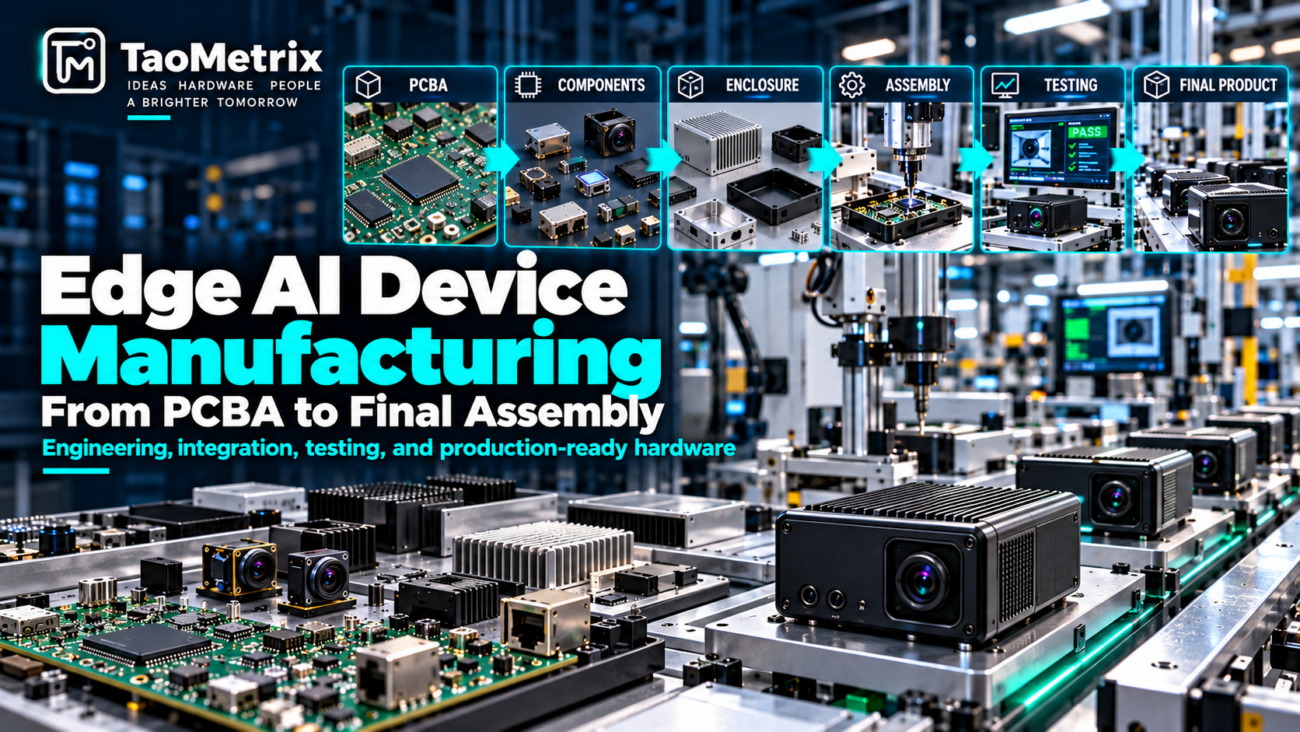
TaoMetrix helps global teams develop and manufacture Edge AI cameras and connected vision devices from prototype review through pilot production and scale-up.
Support can include:
Product and architecture review
Sensor, lens, processor and module selection
PCB prototyping and SMT production
Enclosure, mounting and thermal review
Camera, microphone, wireless and storage integration
BOM optimization and sourcing
Firmware and AI integration coordination
Functional, reliability and production testing
DFM, DFT, fixtures and quality planning
Edge AI camera OEM, ODM and JDM production
Packaging and delivery support
To compare engagement models, read OEM vs ODM: how OBM, JDM and CMT compare. To review a camera project, contact TaoMetrix.
Frequently Asked Questions
What is an Edge AI camera?
An Edge AI camera captures images and runs some or all AI inference locally on the device. It may transmit events, metadata or selected video rather than sending every frame to the cloud.
What is the difference between Edge AI camera OEM and ODM?
In an Edge AI camera OEM project, the brand typically provides a mature design or manufacturing package. In ODM, the manufacturer provides an existing camera platform and adapts it to the brand’s requirements.
How do I choose an image sensor and lens?
Choose them from the use case, object size, distance, field of view, lighting, motion, frame rate and AI requirements. Test the complete optical and AI pipeline rather than selecting by resolution alone.
How should Edge AI performance be tested?
Use representative data and real operating conditions. Measure task quality, false results, latency, sustained throughput, temperature, power and behavior under difficult or invalid inputs.
Which certifications does an Edge AI camera need?
Requirements depend on power, radio functions, interfaces, environment, claims and destination markets. Confirm the plan with qualified laboratories before finalizing the PCB, antennas, enclosure and packaging.
When is an Edge AI camera ready for mass production?
It is ready when the design is controlled, requirements are validated, compliance risks are addressed, components are available, factory tests and provisioning are defined, and pilot production demonstrates acceptable yield and quality.
Conclusion
A successful Edge AI camera OEM project aligns optics, AI computing, power, thermal design, connectivity, firmware, mechanics, security and production testing around a defined real-world task.
The strongest product is not the camera with the highest pixel count or TOPS number. It is the camera that produces reliable decisions in its intended environment and can be manufactured, updated and supported consistently.
TaoMetrix supports Edge AI camera projects from prototype and engineering validation through pilot production and scalable OEM/ODM manufacturing. Contact TaoMetrix to discuss your requirements.