
AI Glasses OEM/ODM: From Product Concept to Scalable Manufacturing | TaoMetrix

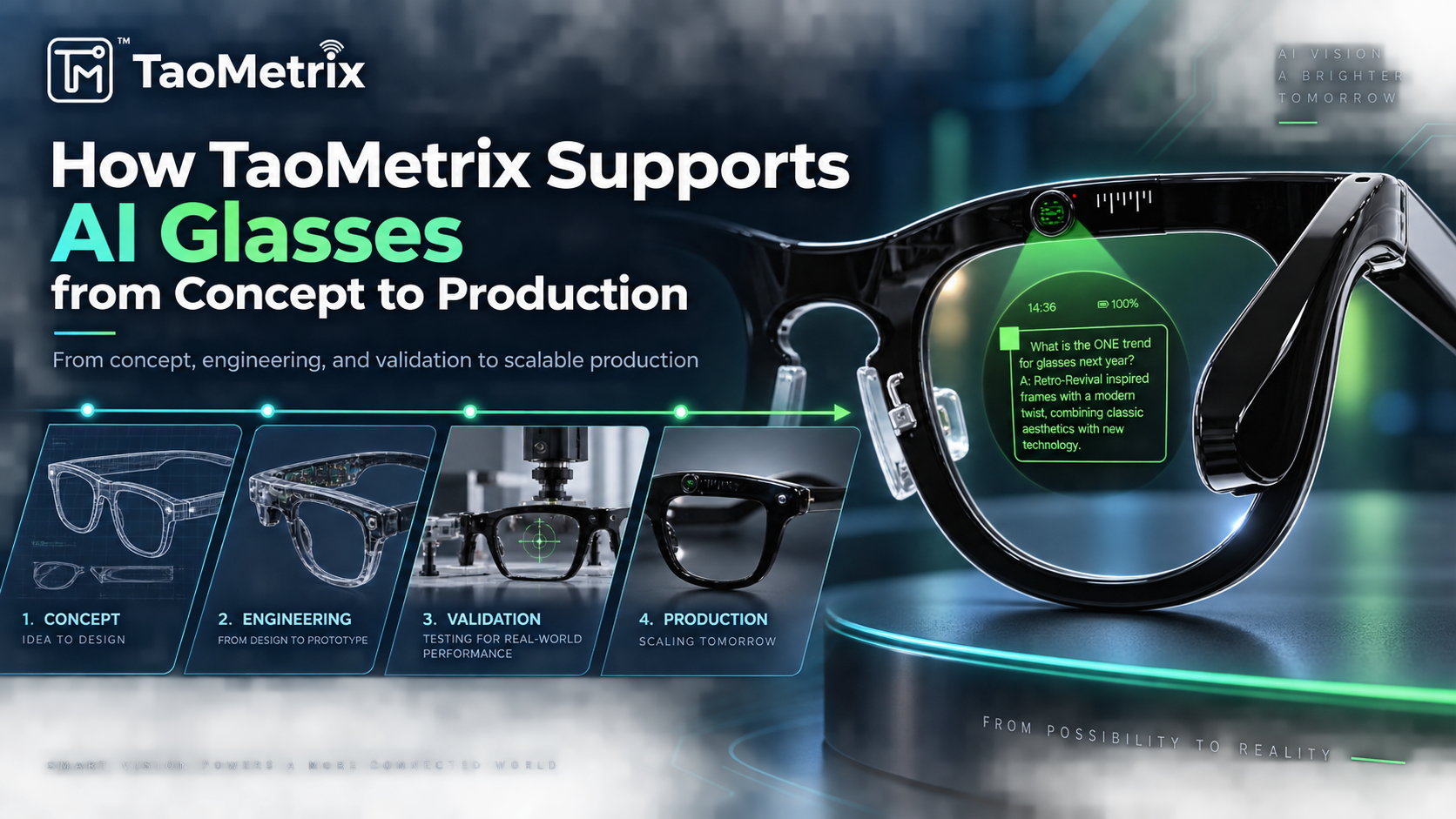
AI glasses combine cameras, microphones, speakers, batteries, wireless communication, embedded software and artificial intelligence in one compact wearable device. For brands and startups, the challenge is not simply adding an AI model. The real challenge is creating a product that is lightweight, comfortable, reliable and manufacturable at a consistent quality level.
TaoMetrix supports AI glasses projects through OEM, ODM and joint development models, helping product teams move from early concepts and engineering prototypes toward testing, pilot production and manufacturing.
What Makes AI Glasses Difficult to Manufacture?
A typical AI glasses project may include camera modules, microphone arrays, speakers, Bluetooth or Wi-Fi, antennas, batteries, charging circuits, flexible PCBA, optical components, custom frames and mobile or cloud software.
All of these components must fit into a very limited space. Camera placement affects the frame design. Microphone placement influences voice recognition and noise reduction. Battery size affects weight and operating time. Processor performance affects heat generation, while antenna placement affects wireless stability.
OEM vs ODM for AI Glasses
OEM Manufacturing
OEM manufacturing is suitable when the customer already has product specifications, industrial design, schematics, PCB files, a BOM, mechanical drawings, firmware requirements and testing standards. The manufacturing partner then focuses on sourcing, assembly, testing, quality control and delivery.
ODM Development
ODM development is suitable when a customer has a product concept but needs support with engineering and industrialization. An ODM project may include hardware platform selection, component integration, mechanical adaptation, prototype development, firmware coordination and pilot production.
Some brands may also choose joint development, in which the customer and manufacturing partner share responsibility for engineering decisions and product industrialization.
Key Engineering Areas in AI Glasses Development
Miniaturized Electronics
AI glasses require compact PCBA layouts and carefully selected components. Flexible circuits may be needed in temples or hinges, where limited space and repeated movement create additional mechanical stress.
Power and Battery Design
Battery capacity must be balanced against product weight, charging time, operating temperature and expected usage. A design that works on a laboratory bench may need further optimization before it is suitable for everyday wear.
Audio Performance
Microphones and speakers should be evaluated for voice pickup, wind noise, echo cancellation, background noise, speaker volume, audio leakage and Bluetooth stability.
Camera and Sensor Integration
Camera performance depends on more than the sensor itself. Lens selection, alignment, calibration, lighting conditions, enclosure tolerances and firmware all influence the final result.
Thermal and Mechanical Reliability
Processors, wireless modules and charging circuits can generate heat inside the frame. Frames, temples, hinges and connectors also need to withstand repeated opening, closing, wearing and transport.
From Prototype to Pilot Production
- Product requirements review
- Hardware and component feasibility assessment
- Mechanical and electronic integration
- Engineering prototype development
- Functional and user testing
- Design for Manufacturing review
- Pilot production
- Quality and reliability validation
- OEM or ODM production launch
Prototype testing should evaluate more than whether the glasses can power on. Teams should verify battery life, wireless connectivity, audio performance, camera alignment, operating temperature, charging safety and long-term wearing comfort.
How TaoMetrix Supports AI Glasses Projects
TaoMetrix is a Shenzhen-based AI hardware development and manufacturing partner. Depending on project requirements, support may include PCBA and SMT assembly, camera and audio integration, battery and charging system assembly, wireless module integration, firmware loading, functional testing, mechanical assembly, DFM review, pilot production, quality inspection and delivery coordination.
For a broader view of the manufacturing process, see the TaoMetrix Shenzhen factory tour and the AI hardware prototype manufacturing guide.
Questions to Ask an AI Glasses Manufacturing Partner
- Can the supplier support wearable electronics and compact PCBA?
- Can it handle camera, audio, wireless and battery integration?
- Does it support engineering prototypes and small-batch production?
- Are functional and reliability tests clearly defined?
- Can the supplier track BOM and engineering changes?
- Are production responsibilities and certification requirements clear?
- Is there a process for protecting confidential project information?
Conclusion
AI glasses are a multidisciplinary hardware product. Their success depends on the interaction between electronics, structure, audio, optics, power, wireless communication, software and manufacturing processes.
The right OEM or ODM partner can help identify engineering risks earlier, improve prototype quality and prepare the product for repeatable production. If you are planning an AI glasses project, prepare your product requirements, target functions, expected quantity, timeline and available design files for an initial manufacturing assessment.
Contact TaoMetrix to discuss your AI glasses OEM or ODM project.