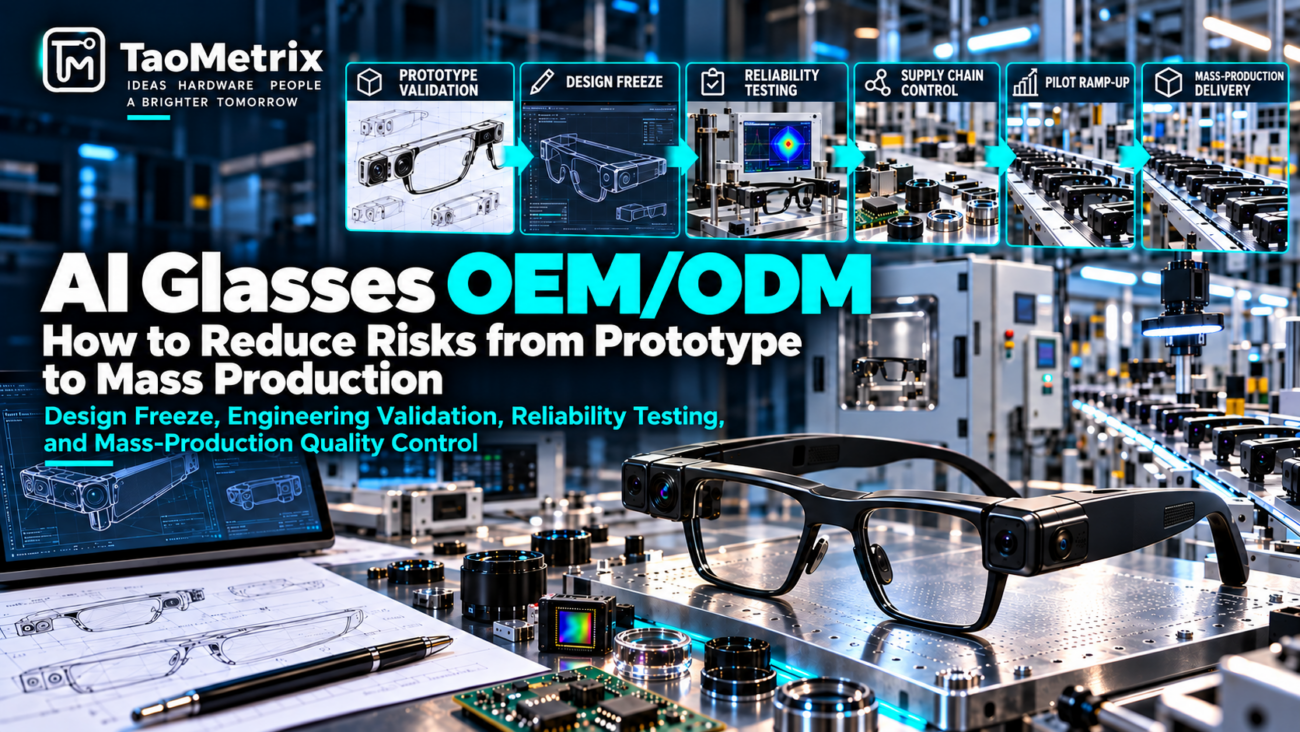
If you are looking for an AI glasses manufacturer, you need more than a factory that can assemble a frame and install a camera.
A suitable AI glasses manufacturing partner should understand:
- Optical and mechanical design
- Cameras and sensors
- Audio and microphones
- Battery and charging
- Wireless communication
- Embedded firmware
- Mobile apps and cloud platforms
- AI model integration
- Testing and certification
- Pilot production and mass production
TaoMetrix helps customers evaluate and develop AI glasses projects through hardware engineering, PCBA, structural assembly, testing, prototypes, and OEM/ODM manufacturing support.
What Is an AI Glasses Manufacturer?
An AI glasses manufacturer is a company that can help produce smart glasses with functions such as:
- Camera capture
- Voice interaction
- Audio playback
- Bluetooth communication
- Wi-Fi or cellular connectivity
- Environmental sensing
- AI-assisted data processing
- Mobile app integration
- Cloud data synchronization
The manufacturing scope may include product engineering, component sourcing, PCBA, mechanical assembly, firmware flashing, functional testing, packaging, and mass production.
Not every eyewear factory has the engineering and electronics capabilities required for AI glasses. Customers should evaluate both product-development capability and manufacturing capability.
What Should You Confirm Before Choosing an AI Glasses Manufacturer?
1. Can the Manufacturer Understand Your Product Use Case?
AI glasses can be designed for very different applications:
- Consumer smart glasses
- Industrial inspection
- Remote assistance
- Education and training
- Retail and logistics
- Healthcare support
- Navigation
- Translation
- Security and field service
The use case affects the product design.
For example, industrial AI glasses may need:
- Stronger mechanical protection
- Longer operating time
- Better environmental resistance
- Higher communication reliability
- Specialized cameras
- Enterprise software integration
Consumer AI glasses may focus more on:
- Comfort
- Weight
- Appearance
- Audio quality
- Camera experience
- Battery life
- Mobile app interaction
2. Can the Manufacturer Support Hardware Engineering?
A complete AI glasses project may require:
- Schematic design
- PCB design
- Component selection
- Camera-module integration
- Microphone integration
- Speaker or audio-module integration
- Battery and charging design
- Wireless-module integration
- Sensor integration
- Thermal management
- Firmware coordination
Ask whether the manufacturer performs the work internally or coordinates qualified engineering and manufacturing partners.
The key question is who is responsible for the final result, quality control, and delivery.
3. Does the Product Need a Camera?
Camera requirements can vary significantly.
You may need to define:
- Camera resolution
- Field of view
- Low-light performance
- Image format
- Video recording
- Local or cloud processing
- Privacy indicator
- Storage method
- Image transmission
- AI vision functions
Potential AI vision features may include:
- Object detection
- Image classification
- OCR
- Visual search
- Scene recognition
- Product recognition
- Remote visual assistance
The camera choice can affect the chipset, memory, power consumption, heat, software, and product cost.
4. How Will the Product Handle Audio?
AI glasses may need:
- Microphones
- Speakers
- Open-ear audio
- Voice pickup
- Noise reduction
- Echo cancellation
- Voice wake-up
- Voice recording
- Audio streaming
Customers should confirm whether audio processing happens locally, through a connected smartphone, or through a cloud service.
5. How Long Should the Battery Last?
AI glasses have limited space for batteries, but cameras, wireless communication, audio, and AI processing can consume significant power.
You should define:
- Target operating time
- Typical daily usage
- Standby time
- Charging method
- Charging-case requirements
- Battery replacement requirements
- Safety and transportation requirements
Longer battery life may require changes to the chipset, camera, software, or product size.
AI Glasses Development Stages
Product Concept
At this stage, customers may have:
- Product ideas
- Sketches
- Reference products
- Competitor samples
- Functional requirements
The first step is to evaluate whether the concept is technically and commercially feasible.
Prototype Development
The prototype stage verifies:
- Product appearance
- Camera and audio functions
- Wireless connection
- Basic battery performance
- Firmware operation
- Mobile-app communication
- Mechanical assembly
EVT: Engineering Validation
EVT checks:
- Hardware design
- Chipset compatibility
- Camera and sensor performance
- Power consumption
- Firmware stability
- Basic thermal performance
DVT: Design Validation
DVT checks:
- Wearing comfort
- Mechanical strength
- Camera position
- Audio quality
- Battery safety
- Wireless stability
- Long-term operation
- Environmental resistance
PVT: Production Validation
PVT confirms whether the factory can produce AI glasses consistently.
Typical checks include:
- Assembly process
- Lens and frame assembly
- Camera positioning
- Firmware flashing
- Functional testing
- Production cycle time
- Product yield
- Packaging
- Batch consistency
What Can TaoMetrix Provide?
TaoMetrix can evaluate and support AI glasses projects through:
- Product-requirement analysis
- Hardware engineering
- PCBA assembly
- Camera and sensor integration
- Battery and charging coordination
- Firmware flashing
- Functional testing
- Mechanical and final assembly
- Prototype manufacturing
- EVT, DVT, and PVT support
- Certification coordination
- Pilot production
- OEM/ODM manufacturing
The final scope depends on the product design, technical files, expected quantity, target market, certification requirements, and delivery schedule.
What Should Customers Prepare?
To receive a more accurate evaluation, prepare:
Product name:
Target users:
Application scenario:
Main functions:
Camera requirements:
Audio requirements:
Sensor requirements:
Battery capacity:
Target runtime:
Wireless functions:
Mobile app requirements:
Cloud-platform requirements:
AI algorithm requirements:
Mechanical files:
PCB files:
BOM:
Firmware:
Reference sample:
Prototype quantity:
First-order quantity:
Expected annual volume:
Target sales market:
Certification requirements:
Target delivery date:
Required TaoMetrix services:
If an item is not confirmed, mark it as:
TBD
How to Evaluate an AI Glasses Manufacturer
Before choosing a supplier, ask:
- Have you produced smart wearable devices?
- Can you support PCBA and final assembly?
- Can you integrate cameras, microphones, speakers, and batteries?
- Can you support prototype and pilot production?
- Do you provide EVT, DVT, and PVT support?
- Can you coordinate CE, FCC, or other certifications?
- How do you test cameras and wireless functions?
- How do you manage firmware versions?
- How do you protect customer designs?
- Who owns the tooling and engineering files?
- Can you support future OEM/ODM mass production?
A good AI glasses manufacturer should be able to explain the technical risks, missing information, testing process, and next project steps.
Frequently Asked Questions
What does an AI glasses manufacturer do?
An AI glasses manufacturer may support hardware engineering, cameras, sensors, PCBA, battery systems, firmware, mechanical assembly, testing, packaging, and OEM/ODM production.
Can TaoMetrix support a custom AI glasses project?
TaoMetrix can evaluate custom AI glasses projects based on product functions, technical files, target quantity, certification requirements, and delivery schedule.
Do I need a complete design before contacting a manufacturer?
No. You can begin with a product concept, sketch, reference product, competitor sample, or functional description. Complete technical files will improve the accuracy of the evaluation.
Can AI glasses be produced in small batches?
Pilot production may be possible depending on the product design, component supply, testing requirements, and order quantity. The appropriate production method should be confirmed during project evaluation.
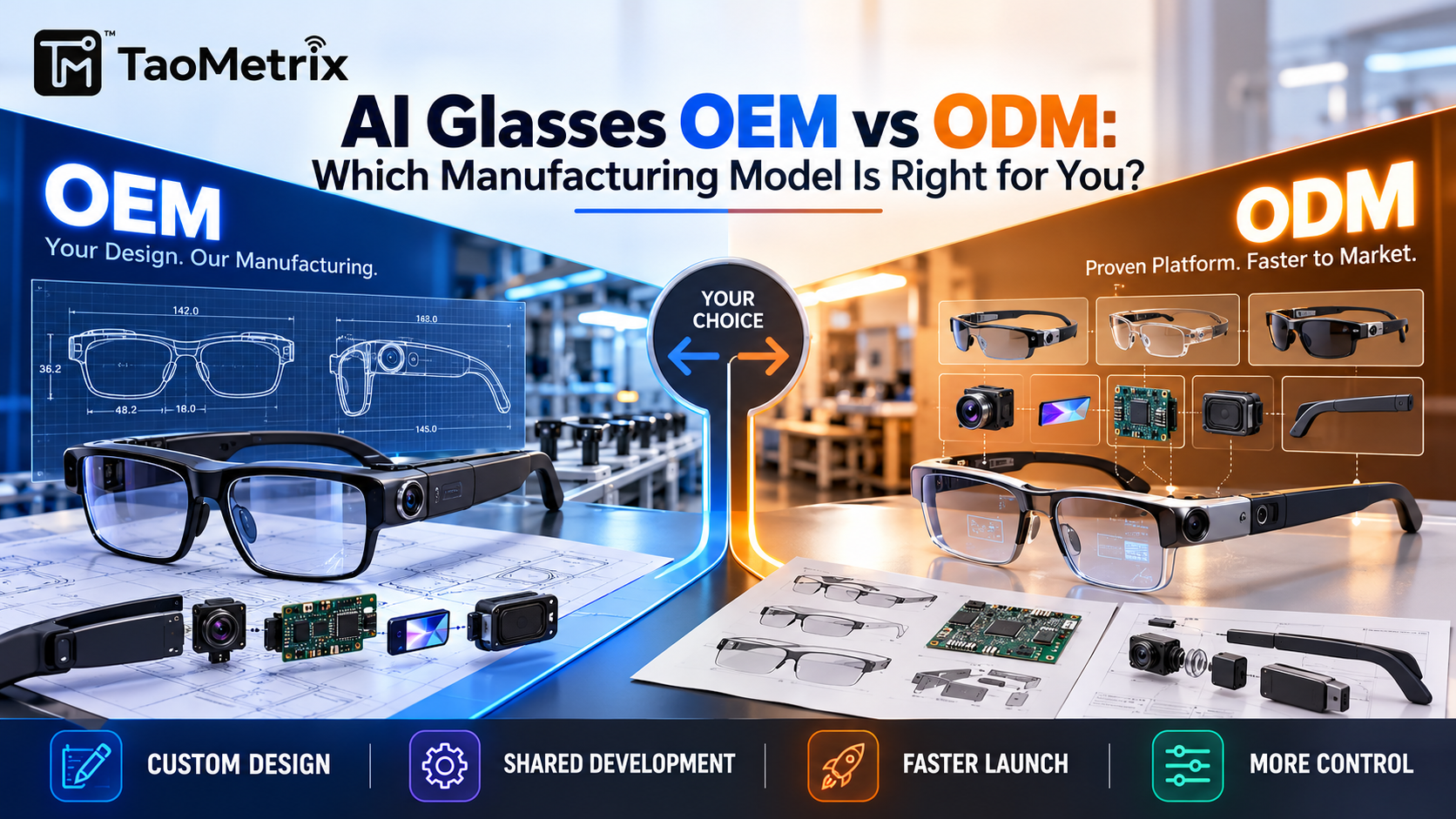
What is the difference between AI glasses OEM and ODM?
With OEM, the customer usually provides the product design and specifications. With ODM, the manufacturer may provide more engineering and product-development support. The exact cooperation model depends on the project scope.
Conclusion
Choosing an AI glasses manufacturer is not only about comparing production prices. You need a partner that understands cameras, audio, sensors, batteries, wireless communication, firmware, mechanical design, testing, and production management.
TaoMetrix can support customers from product evaluation and prototype development to PCBA, functional testing, final assembly, pilot production, and OEM/ODM manufacturing.
If you are developing AI glasses, prepare your product requirements, technical files, target quantity, target market, and delivery schedule. TaoMetrix can then evaluate the appropriate engineering and manufacturing path for your project.