
TaoMetrix OEM vs ODM Manufacturing: OBM, JDM and CMT Explained

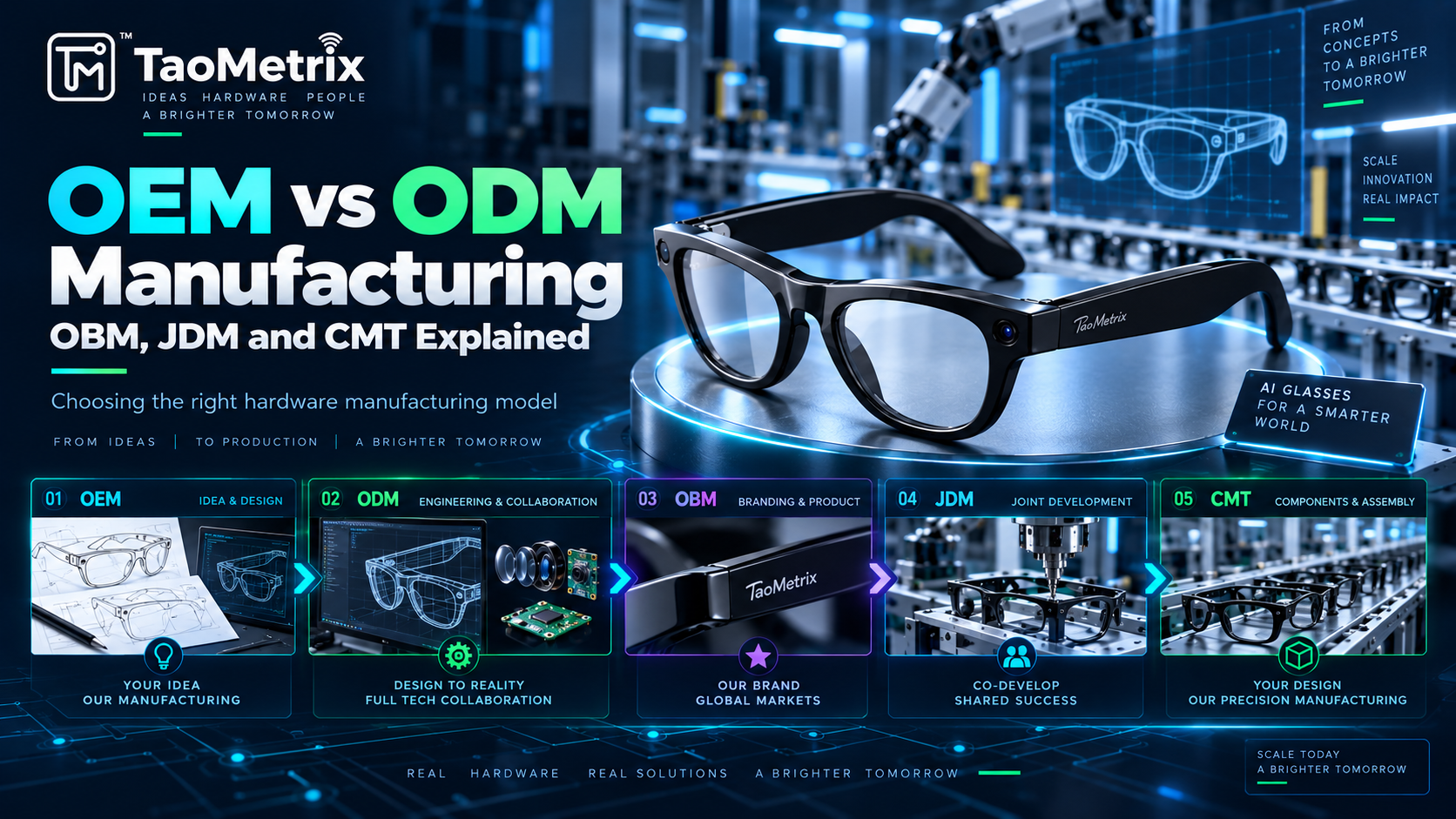
OEM vs ODM is one of the first manufacturing decisions an AI hardware startup must make. However, OEM and ODM are only two of several possible models. OBM, JDM and CMT divide product design, intellectual property, sourcing, manufacturing, branding and commercial responsibility in different ways.
The right AI hardware manufacturing model depends on product maturity, internal engineering capability, ownership requirements, speed, budget and supply-chain control. This guide compares OEM vs ODM, OBM, JDM and CMT and explains when each model is most appropriate.
The short answer is: choose OEM when your design is production-ready; choose ODM when you need an existing platform plus customization; choose JDM when the product requires joint engineering; choose CMT when you supply key materials and mainly need processing or assembly; and use an OBM strategy when one company develops, manufactures, markets and sells its own branded product.
OEM vs ODM: How Do OBM, JDM and CMT Compare?
| Model | Product design | Brand | Materials and sourcing | Manufacturing | Best fit |
|---|---|---|---|---|---|
| OEM | Primarily customer | Customer | Agreed between parties | Manufacturer | Production-ready products |
| ODM | Manufacturer platform with customer customization | Customer | Usually manufacturer-managed | Manufacturer | Faster launch from a proven platform |
| OBM | Brand owner | Manufacturer’s own brand | Brand owner/manufacturer | Brand owner/manufacturer | Companies selling their own products |
| JDM | Customer and manufacturer jointly develop | Usually customer | Shared or manufacturer-managed | Manufacturer | Differentiated AI hardware needing co-engineering |
| CMT | Customer | Customer | Primarily customer-supplied | Factory processes or assembles | Customers controlling key materials and design |
These terms are not globally standardized contract templates. Suppliers may use them differently, so the agreement—not the label—must define responsibilities, ownership, deliverables, and risk.
What Is OEM Manufacturing?
OEM means Original Equipment Manufacturer. In a typical OEM project, the customer owns or controls the product definition and provides a sufficiently complete manufacturing package. The factory sources or receives components, builds the product, tests it, packs it, and ships it according to agreed specifications.
OEM is appropriate when the customer already has:
Product requirements and released specifications
Schematics, PCB files, mechanical CAD, and drawings
BOM with approved manufacturer part numbers
Firmware and production-release procedures
Test plans, fixtures, and acceptance limits
Quality standards, packaging, labels, and manuals
Advantages: strong product and IP control, clearer build-to-print scope, and easier comparison of manufacturing quotations.
Risks: a factory cannot automatically fix an immature design. Weak DFM, unavailable components, incomplete tests, or unstable firmware can still produce low yield, rework, delays, and quality problems.
In an OEM vs ODM comparison, OEM generally gives the customer greater design control but also requires a more mature and production-ready engineering package.
What Is ODM Manufacturing?
ODM means Original Design Manufacturer. The manufacturer provides an existing product platform or engineering foundation and adapts it for the customer’s brand and market.
Customization may include the enclosure, colors, sensors, firmware, mobile app, languages, packaging, or selected hardware features. ODM can be faster than developing an entirely new product because part of the design, sourcing, and production system already exists.
ODM works well when a startup has a clear market requirement but does not need full architectural ownership.
Before selecting ODM, clarify:
Which design elements are standard and which are exclusive?
Who owns tooling, firmware changes, app code, and certifications?
Can the same platform be sold to competitors?
Who maintains the app, cloud service, and OTA system?
What happens if a chipset or component reaches end of life?
Advantages: shorter development time, lower engineering burden, and access to an established supply chain.
Risks: limited differentiation, platform dependence, unclear IP ownership, and long-term software or cloud dependence.
For startups comparing OEM vs ODM, ODM can reduce development time when an existing platform already matches most product requirements.
What Is OBM?
OBM means Original Brand Manufacturer. An OBM company defines, develops, manufactures or outsources, markets, sells, and supports products under its own brand.
OBM is not merely another factory service. It is a business model that includes product strategy, engineering, branding, channels, customer acquisition, warranties, and after-sales support.
For example, a company selling its own branded AI camera or wearable is operating as an OBM, even if external factories perform some production.
Advantages: control of brand, customer relationships, product roadmap, and potential margin.
Risks: the brand carries market, inventory, marketing, compliance, warranty, and channel risk.
What Is JDM?
JDM means Joint Design Manufacturer. The customer and manufacturing partner jointly develop the product and divide engineering responsibilities according to their strengths.
For AI hardware, the customer may provide the AI model, application, cloud platform, user experience, and commercial requirements. The manufacturing partner may lead electronics, mechanical design, BOM optimization, sourcing, DFM, fixtures, testing, and production.
JDM is often suitable for AI cameras, AI glasses, voice devices, robots, wearables, and other products where algorithms, sensors, acoustics, thermal design, power, firmware, and mechanics must be developed together.
Advantages: closer integration between product and manufacturing teams, faster resolution of cross-disciplinary problems, and better production readiness.
Risks: unclear ownership, decision rights, or documentation can create disputes. A JDM agreement should define work packages, review gates, background IP, newly created IP, source-code access, tooling, and change approval.
What Is CMT?
CMT traditionally means Cut, Make, and Trim. In electronics, some suppliers use it more broadly for an arrangement in which the customer supplies key materials, components, or semi-finished goods and the factory performs assembly, processing, testing, or packaging.
A customer might supply custom PCBs, camera modules, batteries, sensors, enclosures, firmware, or test equipment while the factory handles final assembly and inspection.
Advantages: customer control over strategic materials, technology, and sourcing.
Risks: shortages, customs problems, incoming defects, inaccurate kits, and late materials can stop production. The agreement must define material loss, storage, incoming inspection, defective supplied parts, and inventory reconciliation.
How Should AI Hardware Startups Choose Between OEM vs ODM?
Use these questions in order:
Do you have complete, production-ready files? If yes, OEM may fit.
Would an existing platform satisfy the product with limited customization? If yes, consider ODM.
Does the product require shared engineering across AI, electronics, firmware, sensors, and mechanics? Consider JDM.
Do you control and supply most critical materials? CMT may fit the manufacturing scope.
Are you defining, selling, and supporting your own branded product? You are operating as an OBM, regardless of who runs the factory.
| Startup stage | Often suitable model | Reason |
|---|---|---|
| Market test | White label or light ODM | Fast validation with limited investment |
| Working proof of concept | ODM or JDM | Engineering and integration are still required |
| Engineering prototype | JDM | Product and manufacturing decisions must converge |
| Production-ready design | OEM | Customer can provide a controlled build package |
| Customer-controlled components | CMT or OEM | Factory scope focuses on processing and assembly |
| Established branded business | OBM strategy with OEM/ODM/JDM suppliers | Brand owns market and customer responsibility |
The model may change as the product matures. A startup can begin with ODM, move through JDM customization, and use an OEM-style build package for later production. The OEM vs ODM decision should therefore be reviewed again when the product reaches engineering validation, pilot production and scale-up.
What Must Be Defined in the Contract?
Regardless of model, document:
Product specifications and acceptance criteria
Responsibility matrix and engineering deliverables
Existing IP, newly developed IP, licenses, and exclusivity
Tooling ownership, storage, maintenance, and transfer rights
Firmware, app, cloud, AI model, and source-code access
BOM transparency and approved substitutions
Prototype, certification, pilot, and production schedules
NRE fees, MOQ, pricing assumptions, and payment milestones
Quality plan, yield, defect standards, and change control
Compliance documentation and market responsibilities
Warranty, failure analysis, spare parts, and after-sales duties
Data confidentiality, cybersecurity, and supplier access
Termination rights and transfer of files, tooling, and inventory
Never rely on “OEM” or “ODM” alone to answer these questions.
For general guidance on intellectual-property protection and commercialization, startups can consult the World Intellectual Property Organization. Project-specific ownership and licensing terms should still be reviewed by qualified legal counsel.
Common Selection Mistakes
Choosing the lowest quotation without comparing included scope
Calling an early prototype “OEM-ready” before DFM and validation
Assuming ODM automatically includes exclusive design ownership
Starting JDM without an IP and responsibility matrix
Using CMT without clear rules for customer-supplied material defects
Ignoring app, firmware, cloud, and OTA maintenance
Treating certification as the factory’s responsibility without written scope
Moving to mass production without pilot yield and test data
For guidance on development maturity, see TaoMetrix’s AI hardware prototype manufacturing guide. Brands considering wearables can also review the smartwatch OEM/ODM production checklist.
How TaoMetrix Supports AI Hardware Startups
TaoMetrix helps global teams choose and execute an appropriate development and manufacturing model based on product maturity—not merely apply a label.
Support can include:
Product and prototype review
Hardware architecture and engineering coordination
PCB prototyping and SMT production
Mechanical and enclosure development
Sensor, camera, microphone, and wireless integration
BOM optimization and component sourcing
DFM, DFT, fixtures, and quality planning
Functional and reliability validation
Pilot production and manufacturing ramp-up
OEM, ODM, and JDM production support
Packaging and delivery coordination
To evaluate the right model for a specific product, contact TaoMetrix.
Frequently Asked Questions
What is the main difference between OEM and ODM?
OEM usually manufactures from a customer-controlled design, while ODM provides an existing design or platform and customizes it for the customer. Actual ownership and scope depend on the contract.
Is ODM cheaper than OEM?
ODM can reduce initial engineering and tooling costs when an existing platform fits the requirement. It is not always cheaper over the full product lifecycle because customization, software, cloud services, exclusivity, and supplier dependence can add cost.
Is JDM better for AI hardware?
JDM is often useful when AI software, sensors, electronics, acoustics, thermal design, firmware, and mechanics require joint development. It is not automatically better; it requires clear ownership and capable teams on both sides.
Can a startup move from ODM to OEM later?
Sometimes, but only if the startup has contractual rights and access to the necessary design files, firmware, tooling, test systems, and supply-chain information. These transfer rights should be negotiated before development.
Who owns the IP in an ODM or JDM project?
There is no universal answer. The contract should distinguish pre-existing IP, platform IP, customer IP, jointly developed IP, licenses, exclusivity, and ownership of project deliverables.
Which model is best for an early AI hardware prototype?
ODM can fit a product based on an existing platform. JDM can fit a differentiated product requiring joint engineering. A startup should choose after identifying technical gaps, ownership requirements, budget, and target timeline.
Conclusion: Choosing OEM vs ODM and Other Models
OEM vs ODM is ultimately a decision about design maturity, control and responsibility. OBM, JDM and CMT provide additional options when a company owns the brand, needs joint engineering or supplies key materials. The best model is the one that matches the startup’s internal capability, IP strategy, supply-chain control, budget and commercial plan.
Define the work in a contract, validate the product before scaling, and expect the manufacturing model to evolve as the product matures.
TaoMetrix supports AI hardware teams from prototype and engineering review through pilot production and scalable manufacturing. Contact TaoMetrix to discuss the right path for your project.





3 Gedanken zu „TaoMetrix OEM vs ODM Manufacturing: OBM, JDM and CMT Explained“