
Producción OEM/ODM de relojes inteligentes: lo que las marcas deben tener en cuenta antes de la fabricación

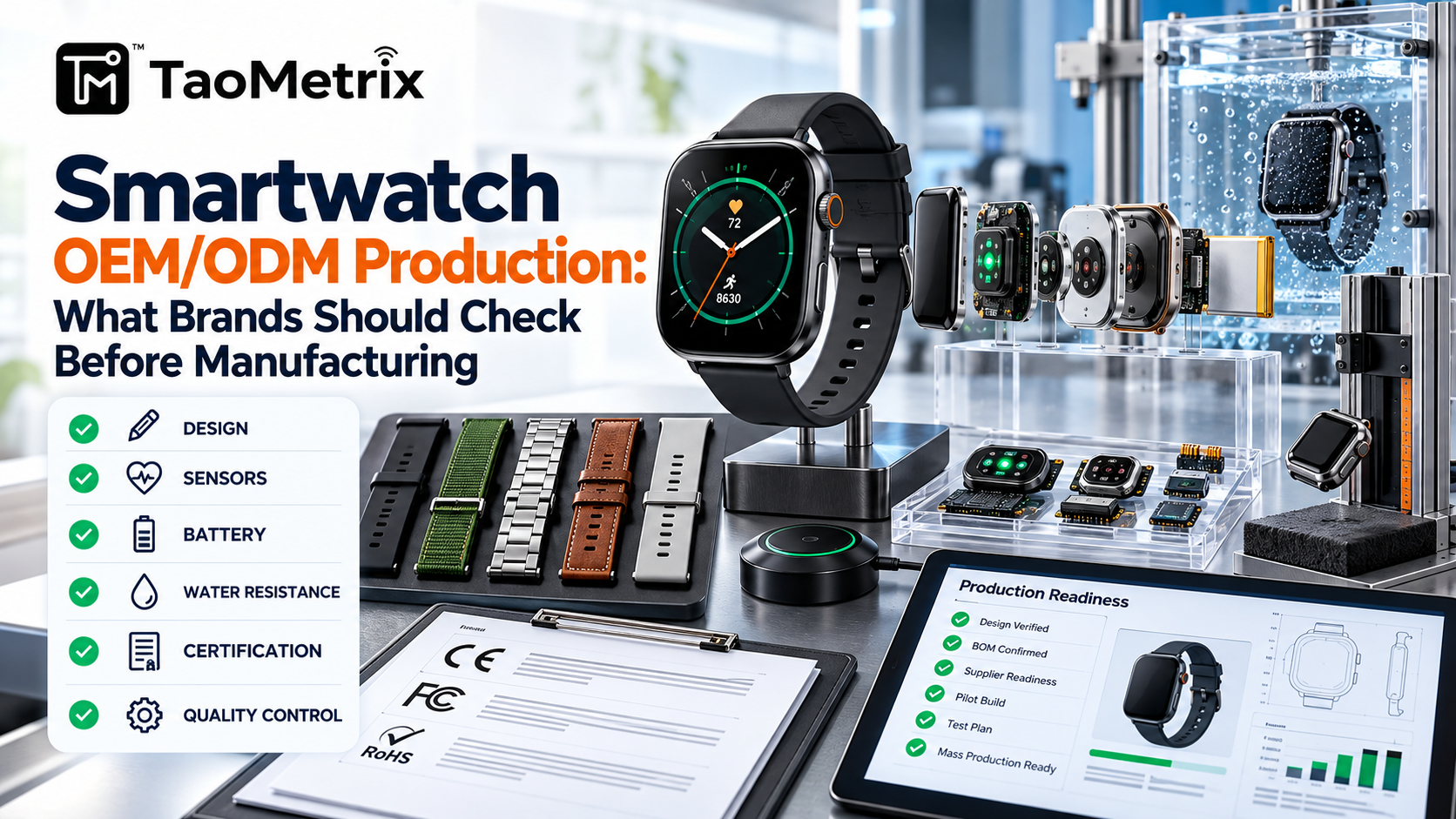
Smartwatch OEM/ODM production requires more than selecting a reference design and adding a logo. Before mass production, brands should validate product positioning, hardware architecture, sensors, firmware, mobile apps, battery performance, mechanical design, compliance, quality control, and supply-chain readiness.
The practical goal is simple: prove that the smartwatch works reliably for its intended users, can be manufactured consistently, and meets the requirements of its target markets.
Quick Answer: What Should Brands Check Before Smartwatch OEM/ODM Production?
Before approving a smartwatch for production, confirm these ten areas:
Target users, price range, and core use cases
Chipset, display, memory, connectivity, and component availability
Sensor accuracy under realistic wearing conditions
Firmware stability and over-the-air update capability
Mobile app compatibility, localization, privacy, and data ownership
Battery life under defined normal-use and heavy-use scenarios
Comfort, materials, charging design, and waterproofing
Market-specific certification and Bluetooth qualification
Pilot-production yield, test coverage, and defect standards
Packaging, logistics, spare parts, warranty, and after-sales support
Brands should not approve mass production until measurable acceptance criteria have been agreed for each applicable item.
Smartwatch OEM vs. ODM: What Is the Difference?
| Model | What the brand provides | What the manufacturer provides | Best suited to |
|---|---|---|---|
| OEM | Product design, specifications, and production files | Sourcing, manufacturing, assembly, and testing | Brands with a mature design and engineering package |
| ODM | Product requirements and customization brief | Existing platform, engineering adaptation, manufacturing, and testing | Brands seeking faster development with controlled customization |
| White label | Logo, packaging, and limited appearance choices | Ready-made product and standard software | Market testing and fast, low-complexity launches |
The labels are sometimes used differently by suppliers, so the contract should define ownership of tooling, firmware, app source code, cloud services, test fixtures, certifications, and production data. For a broader comparison, see TaoMetrix’s guide to OEM, ODM, OBM, JDM, and CMT for AI hardware startups.
1. Define Product Positioning Before Smartwatch OEM/ODM Production
Start with the user and use case—not the component list. Product positioning determines the hardware platform, sensors, battery, enclosure, software scope, certification plan, and target cost.
| Product type | Priorities to validate |
|---|---|
| Entry-level smartwatch | Cost, appearance, stable Bluetooth, notifications, basic activity tracking |
| Sports watch | GPS performance, heart-rate consistency, battery life, waterproofing, durability |
| Wellness watch | Sensor consistency, sleep tracking, long-term comfort, responsible claims |
| Kids’ smartwatch | Location, calling, parental controls, privacy, battery life, durability |
| AI smartwatch | Microphone and speaker quality, latency, connectivity, cloud cost, privacy, system stability |
Create a one-page product requirements document that defines target users, primary use cases, required features, target retail price, target manufacturing cost, intended countries, battery-life target, and launch volume.
2. Evaluate the Complete Hardware Platform
A smartwatch platform normally includes the chipset, display, memory, sensors, battery, Bluetooth or cellular connectivity, microphone, speaker, vibration motor, antennas, charging system, and mechanical structure.
Do not compare components only by specification-sheet numbers. Ask whether the complete system can meet the product requirements:
Can the processor support all planned features with acceptable response time?
Is memory sufficient for firmware, fonts, languages, watch faces, and future updates?
Is the display readable outdoors and responsive at the intended power level?
Does the antenna perform consistently when the watch is worn on the wrist?
Are the microphone and speaker suitable for calls or voice interaction?
Are critical components available for the expected production lifecycle?
Are approved alternatives available if a component becomes unavailable?
A high-spec component cannot compensate for weak system integration.
3. Validate Sensors Under Real Wearing Conditions
Common smartwatch sensors include photoplethysmography-based heart-rate and SpO2 modules, accelerometers, gyroscopes, GNSS receivers, temperature sensors, and barometers. More sensors do not automatically create a better product.
Testing should reflect variation in wrist size, movement, strap tightness, skin contact, ambient temperature, sweat, tattoos, and outdoor conditions. Define the intended use of every metric and the conditions under which performance will be accepted.
Consumer wellness products should avoid unsupported diagnostic or medical claims. A product intended for medical use may require a different regulatory strategy, clinical evidence, and market-specific approvals. Regulatory requirements should be confirmed with qualified compliance professionals for each target country.
4. Treat Firmware and the Mobile App as One Product
Many smartwatch failures are experience failures rather than broken hardware. Common complaints include Bluetooth disconnections, delayed notifications, slow synchronization, failed firmware updates, missing data, translation errors, inaccurate battery indicators, and inconsistent behavior across phones.
Before production, confirm:
Who owns and maintains the firmware and mobile app?
Can the app use the brand’s name, visual identity, domains, and developer accounts?
Which Android and iOS versions and phone models are supported?
Are OTA firmware updates supported, recoverable, and signed?
Can the product support all required languages without layout errors?
Where is user data stored, and who can access or export it?
Can the watch integrate with the brand’s app or approved third-party platforms?
What happens if the original app or cloud supplier stops providing service?
These questions should be answered in the commercial agreement, not left as informal promises.
5. Measure Battery Life With Defined Test Scenarios
“Up to seven days” is not a useful engineering target unless the test conditions are defined. Battery life changes with screen brightness, display-on time, notification frequency, heart-rate sampling, Bluetooth activity, GPS use, calls, voice interaction, vibration, temperature, firmware optimization, and battery aging.
Require at least three documented scenarios:
| Scenario | Example conditions to define |
|---|---|
| Standby | Display behavior, connectivity state, background sensing |
| Normal use | Notifications, workouts, heart-rate sampling, screen-on time |
| Heavy use | GPS, calls, voice features, maximum practical sensing frequency |
Record test conditions, sample size, firmware version, battery capacity, ambient temperature, and pass/fail limits. Marketing claims should be based on repeatable results rather than a single best-case test.
6. Validate Enclosure, Comfort, Charging, and Waterproofing
A smartwatch enclosure combines the case, display, back cover, buttons, sensor window, strap connection, seals, microphone and speaker openings, charging contacts, adhesives, and surface finishes. These parts interact, so mechanical validation should begin before final tooling approval.
Check:
Wrist comfort, weight, thickness, and pressure points
Material selection and skin-contact considerations
Button feel and repeated-use durability
Strap attachment strength and compatibility
Charging contact alignment, wear, and corrosion resistance
Display bonding and cosmetic consistency
Drop, vibration, sweat, temperature, and wear testing
Water-ingress performance after aging and repeated use
IP67 or IP68 should not be treated as a marketing phrase. IP ratings are defined through IEC 60529, which classifies enclosure protection against dust and liquids. The claimed rating should be supported by testing appropriate to the final production design. See the IEC explanation of IP ratings.
7. Plan Compliance Before Finalizing the Design
Certification requirements depend on the product configuration and sales market. A typical plan may involve radio, electromagnetic compatibility, electrical safety, battery, materials, environmental, labeling, privacy, and transportation requirements.
For the United States, radio-frequency devices may require authorization before marketing or importation; confirm the applicable route through the FCC Equipment Authorization program.
For Bluetooth-enabled products, branding a device as a Bluetooth product does not end with selecting a qualified module. The Bluetooth SIG states that Bluetooth products must complete the applicable qualification process before sale or distribution. Review the Bluetooth Qualification Process early.
For European markets, determine the applicable CE-related requirements, including the Radio Equipment Directive and RoHS obligations, with an accredited laboratory or compliance specialist. Do not wait until packaging is complete to identify required reports, declarations, labels, or technical documentation.
8. Use a Measurable DVT and Pilot-Production Plan
Do not move directly from a working sample to mass production. Use staged validation:
Engineering Validation Test (EVT): Verify core architecture and function.
Design Validation Test (DVT): Verify the near-final design against product and reliability requirements.
Production Validation Test (PVT): Verify tooling, assembly, test fixtures, operator instructions, and production consistency.
Pilot production: Measure yield, cycle time, defect patterns, rework, and outgoing quality before scaling.
Agree on a written quality plan covering incoming inspection, in-process testing, functional testing, cosmetic standards, sampling rules, traceability, firmware version control, failure analysis, and change approval.
Ask the supplier to provide measurable production data rather than only stating that quality is “stable.”
9. Clarify Commercial and Supply-Chain Ownership
Before placing a purchase order, define:
Minimum order quantity and price-break assumptions
Tooling ownership and maintenance
Non-recurring engineering fees
BOM transparency and approved substitutes
Lead times for samples, certification, pilot production, and mass production
Firmware, app, cloud, and source-code ownership
Engineering-change and component-substitution approval
Defect responsibility, warranty terms, and spare-parts policy
Packaging, labeling, manuals, barcodes, and shipping tests
Production records and product traceability
The lowest quoted unit price may not be the lowest total cost if it excludes app maintenance, certification, tooling, rework, cloud services, warranty replacements, or engineering changes.
10. How Should Brands Choose a Smartwatch OEM/ODM Partner?
Choose a partner based on evidence of system integration and production control, not only a showroom of existing models.
Ask potential suppliers for:
-
Relevant smartwatch or wearable project experience
-
A clear engineering and responsibility matrix
-
Sample test plans and quality records
-
Firmware and app maintenance arrangements
-
Component traceability and change-control procedures
-
Pilot-production capability
-
Failure-analysis and corrective-action processes
-
Support for certification, packaging, and international delivery
For a differentiated product, confirm that the partner can coordinate electronics, firmware, app development, mechanical engineering, testing, and manufacturing as one program.
How TaoMetrix Supports Smartwatch Projects
TaoMetrix supports global brands developing smartwatches, AI wearables, and connected hardware through the path from product definition to scalable manufacturing.
Project support can include:
-
Product and solution review
-
Chipset and sensor selection
-
BOM review and cost optimization
-
PCBA and SMT production
-
Mechanical and enclosure review
-
Firmware and app integration coordination
-
Functional and reliability testing
-
Pilot production and production ramp-up
-
OEM/ODM manufacturing
-
Packaging and delivery support
This integrated approach helps reduce communication gaps between brands, engineering teams, component suppliers, software developers, test laboratories, and production partners. To discuss a project, contact TaoMetrix.
Frequently Asked Questions
What is smartwatch OEM/ODM production?
Smartwatch OEM/ODM production is the process of engineering and manufacturing a smartwatch for a brand. In an OEM project, the brand typically provides a mature design or production package. In an ODM project, the manufacturer provides an existing platform and adapts the hardware, firmware, app, enclosure, or packaging to the brand’s requirements.
How long does smartwatch OEM/ODM development take?
Timing depends on whether the project is white label, platform customization, or a new design. The schedule should account for requirements, samples, firmware and app work, tooling, validation, certification, pilot production, and component lead times. A reliable schedule can only be created after the scope and target markets are defined.
What is the typical smartwatch OEM/ODM MOQ?
MOQ varies by platform, customization level, tooling, components, packaging, and supplier. White-label products usually support lower starting quantities than heavily customized or newly tooled products. Brands should request separate MOQ assumptions for samples, pilot production, and mass production.
Can a smartwatch use a brand’s own mobile app?
Often yes, but integration depends on the chipset platform, firmware interfaces, SDK availability, data format, OTA architecture, and supplier cooperation. App ownership, source-code access, maintenance responsibility, and data control should be agreed before development begins.
Which certifications does a smartwatch need?
Requirements depend on the radio functions, battery, claims, materials, and destination markets. Possible areas include FCC authorization in the United States, CE-related requirements in Europe, RoHS, Bluetooth qualification, battery transport testing, and market-specific labeling. Confirm the final plan with qualified laboratories or compliance specialists.
Is IP68 enough to prove that a smartwatch is waterproof?
No single label proves performance under every real-world condition. The IP rating should correspond to defined testing under IEC 60529, and the final product should also be evaluated for its intended use, production variation, aging, sealing consistency, and warranty claims.
Conclusion
Successful smartwatch OEM/ODM production is a controlled validation process, not a logo-printing exercise. Brands should define the product, verify the complete hardware and software experience, test realistic battery and sensor performance, plan compliance early, and validate production before scaling.
The best smartwatch is not the one with the longest specification sheet. It is the one that performs consistently for its intended users, can be manufactured repeatedly, and can be supported after launch.
TaoMetrix helps global teams move smartwatch and AI wearable concepts through engineering validation, pilot production, and scalable OEM/ODM manufacturing. Contact TaoMetrix to review your product requirements and production plan.