Choosing between an RK3588 AI box and an RK3576 AI box is not simply a matter of comparing processor specifications. The right platform depends on your AI workload, camera requirements, power budget, installation environment, software stack, production quantity, and long-term support plan.
Both platforms can be considered for edge AI applications such as industrial vision, robotics, smart retail, intelligent gateways, and local video analytics. However, they are designed for different product priorities.
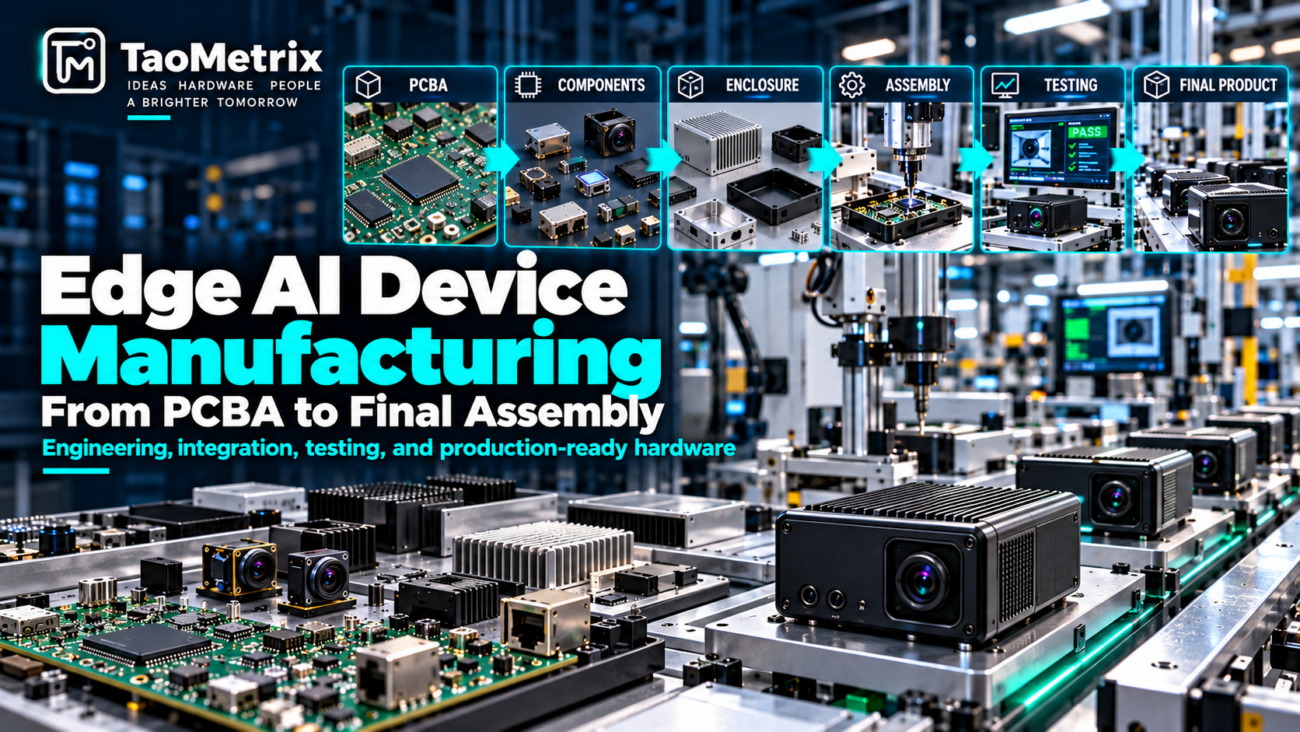
TaoMetrix helps customers evaluate, customize, and manufacture AI hardware from engineering prototypes to OEM/ODM production.
Quick Answer: Which Platform Should You Choose?
Choose RK3588 when your product requires:
- Higher overall computing performance
- More demanding video processing
- More expansion bandwidth
- Multiple high-speed interfaces
- Complex industrial vision
- Robotics or multi-camera applications
- Greater headroom for future upgrades
Choose RK3576 when your product prioritizes:
- Lower system cost
- Lower power consumption
- Compact product design
- Balanced edge AI performance
- Fanless or simplified thermal design
- Smart terminals and industrial gateways
- Large-scale deployment with controlled workloads
The final decision should be based on measured application performance rather than theoretical specifications alone.
RK3588 vs RK3576: At-a-Glance Comparison
| Evaluation Area | RK3588 | RK3576 |
|---|
| Product positioning | Higher-performance edge AI platform | Balanced edge AI and AIoT platform |
| Typical use | Complex vision, robotics, multi-stream video | Smart terminals, gateways, moderate AI workloads |
| AI inference | Suitable for demanding local inference | Suitable for defined and optimized workloads |
| Video capability | Stronger multimedia and display headroom | Suitable for common edge video applications |
| Expansion | More bandwidth for storage and peripherals | More cost- and power-conscious designs |
| Thermal design | May require more careful cooling | Often easier to design for lower power |
| Cost priority | Higher performance investment | Better for cost-sensitive products |
| Best fit | Performance and expansion | Efficiency and deployment scale |
The exact performance depends on the board design, memory, storage, firmware, camera pipeline, operating system, and AI model.
What Makes RK3588 a Strong Choice?
RK3588 is often considered when a product needs more system headroom. It can be a strong candidate for applications that combine AI inference, video processing, multiple peripherals, and local application software.
Potential RK3588 applications include:
- Industrial defect detection
- Multi-camera video analytics
- Robot perception
- Autonomous inspection
- Intelligent NVR systems
- High-resolution display terminals
- Smart city equipment
- Edge AI gateways
- Local AI and multimodal applications
For example, an industrial vision product may need to receive multiple camera streams, run an AI model, communicate with a PLC, store event images, and display results at the same time. In this type of system, additional computing and I/O headroom can simplify future upgrades.
However, a higher-performance platform does not automatically guarantee better results. The actual system still requires model conversion, thermal validation, camera testing, and end-to-end latency measurement.
What Makes RK3576 a Strong Choice?
RK3576 is more suitable when the product needs a balanced combination of AI capability, power efficiency, cost, and compact design.
Potential applications include:
- Smart retail terminals
- Industrial gateways
- Lightweight machine vision
- Digital signage
- Voice-enabled terminals
- Service robots
- Smart cameras
- Edge IoT devices
- Small autonomous systems
For a product with one or a few cameras, a defined AI model, moderate processing requirements, and a controlled installation environment, RK3576 may provide a more efficient product architecture.
A lower-power platform can also simplify:
- Enclosure design
- Fanless cooling
- Power supply selection
- Battery-powered deployment
- Product cost control
- Large-scale installation
The key is to confirm that the chosen platform has enough performance margin for the complete application, not just the AI model itself.
RK3588 vs RK3576 for Industrial Vision
Industrial vision customers should evaluate the full image-processing pipeline:
Camera trigger
→ Image capture
→ Pre-processing
→ AI inference
→ Result decision
→ PLC or actuator response
Important questions include:
- How many cameras are required?
- What is the image resolution?
- What is the target frame rate?
- What is the maximum acceptable latency?
- Is the model compatible with the Rockchip toolchain?
- What happens when confidence is low?
- Can the system continue after a camera or network failure?
- How does performance change at high temperature?
RK3588 may be preferred for more complex multi-camera or high-bandwidth systems. RK3576 may be sufficient for a defined inspection task with limited camera inputs and optimized models.
The correct platform should be confirmed through representative production samples and actual workload testing.
RK3588 vs RK3576 for Robotics
Robotics products often combine:
- Cameras
- Depth sensors
- LiDAR
- IMUs
- Motors
- Robot controllers
- Wireless communication
- Local AI models
RK3588 may be more appropriate when the robot needs additional computing and expansion capacity. RK3576 may be attractive for compact robots, service devices, and products with a controlled sensor configuration.
Before selecting a platform, confirm:
- Camera and sensor interfaces
- CAN, UART, USB, and Ethernet requirements
- Response-time limits
- Operating temperature
- Power source
- Mechanical space
- Vibration conditions
- Software update method
Software and AI Model Compatibility
Hardware selection should happen together with software planning.
Customers should verify:
- Operating system
- Kernel and board-support package
- RKNN toolkit compatibility
- Model conversion requirements
- INT8 quantization results
- Camera drivers
- Inference runtime
- Container support
- Remote update process
- Security and recovery functions
A model that runs successfully on a development board may still require optimization before it can operate reliably in a production product.
For this reason, the engineering team should test the complete combination of:
- Processor
- Memory
- Camera
- AI model
- Runtime
- Driver
- Application software
- Thermal solution
Thermal and Power Considerations
Thermal design is one of the most important differences between a development demo and a production-ready AI box.
RK3588 products may need more attention to:
- Heat-sink size
- Fan or fanless design
- Airflow
- Enclosure material
- Sustained workload
- Ambient temperature
- Performance throttling
RK3576 may simplify low-power or compact designs, but it still requires validation under the real workload.
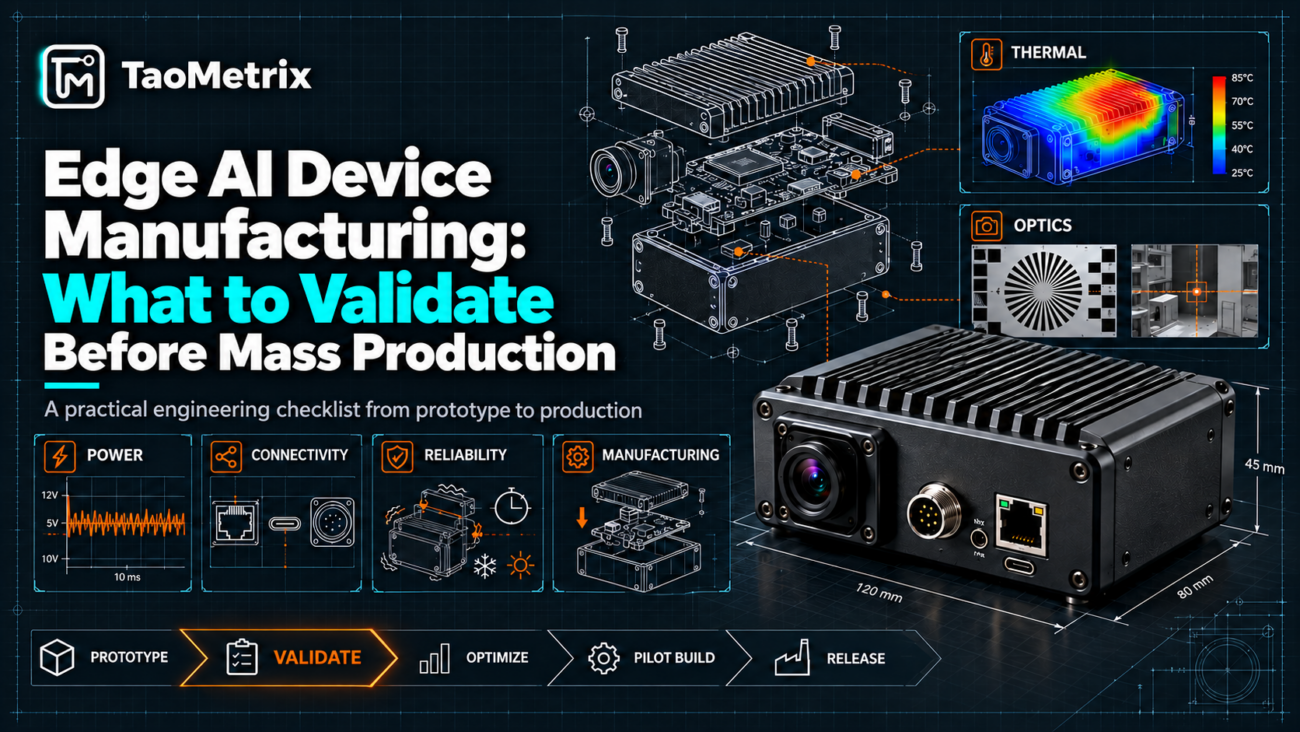
Testing should include:
- Full AI load
- Long-duration operation
- High ambient temperature
- Maximum camera input
- Enclosed installation
- Restart and recovery
- Power fluctuation
Which Platform Is Better for Mass Production?
Neither platform is universally better. Production suitability depends on the product requirements.
RK3588 may be better when:
- Performance headroom is important
- The system needs multiple high-speed interfaces
- The product may gain more AI functions later
- The device handles several video streams
- The product requires complex robotics integration
RK3576 may be better when:
- Unit cost is highly sensitive
- The application workload is well defined
- Power consumption must be minimized
- The product needs a compact or fanless enclosure
- The device will be deployed in large quantities
In both cases, customers should confirm component availability, firmware support, production documentation, testing methods, and long-term supply planning before committing to mass production.
How TaoMetrix Helps You Choose
TaoMetrix can support a structured platform evaluation based on your actual product requirements.
The review may include:
- Application and workload analysis
- Camera and sensor requirements
- Processor and memory selection
- Interface planning
- Power and thermal evaluation
- AI model deployment review
- Custom PCBA planning
- Prototype development
- Engineering validation
- DFM review
- Pilot production
- OEM/ODM assembly
- Final delivery coordination
TaoMetrix does not recommend a platform based only on a single specification. The decision should consider your target product, installation environment, development schedule, quantity, and future upgrade plan.
What Should You Prepare Before Requesting an Evaluation?
Prepare the following information:
- Product application
- Target users
- AI model or algorithm
- Camera quantity and resolution
- Required interfaces
- Target inference speed
- Power supply
- Enclosure dimensions
- Operating temperature
- Prototype quantity
- Expected production volume
- Target market
- Certification expectations
- Delivery schedule
- Existing BOM or development board
If you do not have a complete technical specification, a product description and application scenario are enough for an initial discussion.
Frequently Asked Questions
Is RK3588 always better than RK3576?
No. RK3588 may provide more performance and expansion headroom, while RK3576 may offer a better balance for cost-sensitive and lower-power products. The right choice depends on the workload.
Can both platforms run edge AI models?
Both platforms can be evaluated for edge AI applications. Model compatibility, conversion, quantization, runtime, and actual inference performance must be tested on the target configuration.
Which platform is better for industrial vision?
RK3588 may be more suitable for complex or multi-camera systems. RK3576 can be suitable for defined workloads with fewer cameras and controlled processing requirements.
Can TaoMetrix customize an RK3588 or RK3576 AI box?
Depending on the project, customization may include PCBA, interfaces, enclosure, thermal design, firmware configuration, branding, packaging, and final assembly.
Can TaoMetrix support low-volume prototypes?
Prototype and pilot-production support should be evaluated based on the required quantity, technical documents, customization level, and schedule.
Conclusion
The choice between RK3588 and RK3576 should be made by looking at the complete product rather than one processor specification.
RK3588 is generally a stronger candidate for demanding AI workloads, multi-camera systems, robotics, and products that need more expansion headroom. RK3576 may be a better fit for compact, cost-sensitive, and power-conscious edge AI products with clearly defined workloads.
TaoMetrix helps customers move from platform selection to custom PCBA, prototype validation, pilot production, OEM/ODM manufacturing, and final delivery.
Need help choosing between RK3588 and RK3576? Share your AI model, camera requirements, interfaces, power limits, target quantity, and delivery plan with TaoMetrix for an initial technical review.
The comparison approach in this article is informed by public Rockchip platform information and published RK3588/RK3576 AI box guides, including Seeed Studio’s platform overview and public comparative materials. Actual product performance should be confirmed through project-specific testing