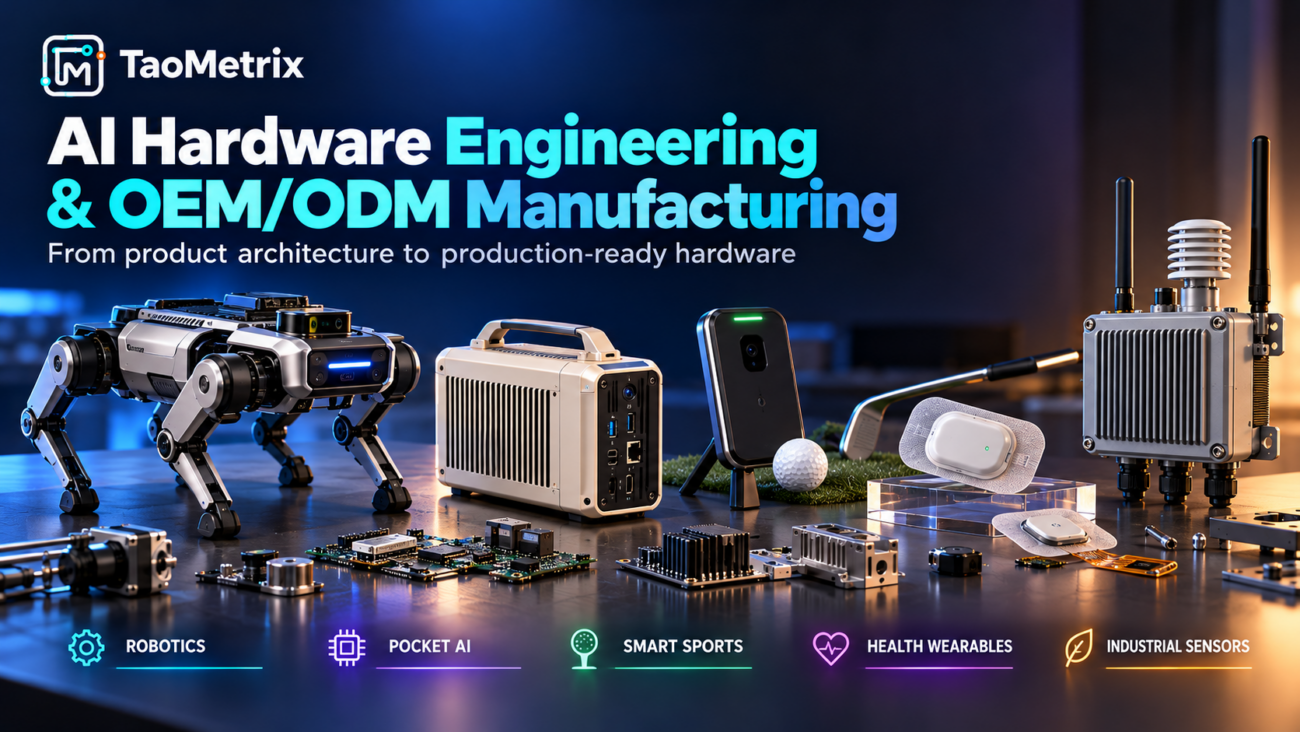
AI hardware manufacturing is becoming increasingly important as startups move from software-only products to local AI computers, edge AI devices, and portable computing terminals.
Tiiny AI Pocket Lab is a useful example of this transition. Its Kickstarter campaign presents a compact AI computing device designed for local model deployment, open-source models, AI agents, and OpenAI API compatibility. The project attracted 2,181 backers and raised more than $3 million, according to its Kickstarter campaign.
For AI hardware startups, the key challenge is not only building a working prototype. The product must also be engineered for thermal stability, repeatable assembly, reliable testing, supply-chain control, and scalable production.
What Is Tiiny AI Pocket Lab?
Tiiny AI Pocket Lab is positioned as a compact local AI computing device. Instead of relying entirely on cloud-based AI services, this type of product aims to provide users with local access to AI models and applications.
Its product concept reflects several growing trends in AI hardware:
- Local AI inference
- Edge computing
- Portable AI workstations
- Open-source models and agents
- Lower dependence on cloud APIs
- More control over private data
- Direct hardware access for developers
These features create opportunities for developers, researchers, businesses, and advanced users who need local AI capabilities.
However, a successful product requires more than a powerful processor. The computing platform, storage, memory, cooling system, power architecture, enclosure, firmware, and user interface must work together as one reliable product.
What AI Hardware Manufacturing Challenges Does This Product Reveal?
AI hardware manufacturing involves more engineering coordination than ordinary consumer electronics.
Thermal Management
Local AI devices may operate under sustained computing loads. This creates heat that must be managed through:
- Heat sinks
- Fans or passive cooling
- Internal airflow
- Enclosure design
- Thermal interface materials
- Long-duration stress testing
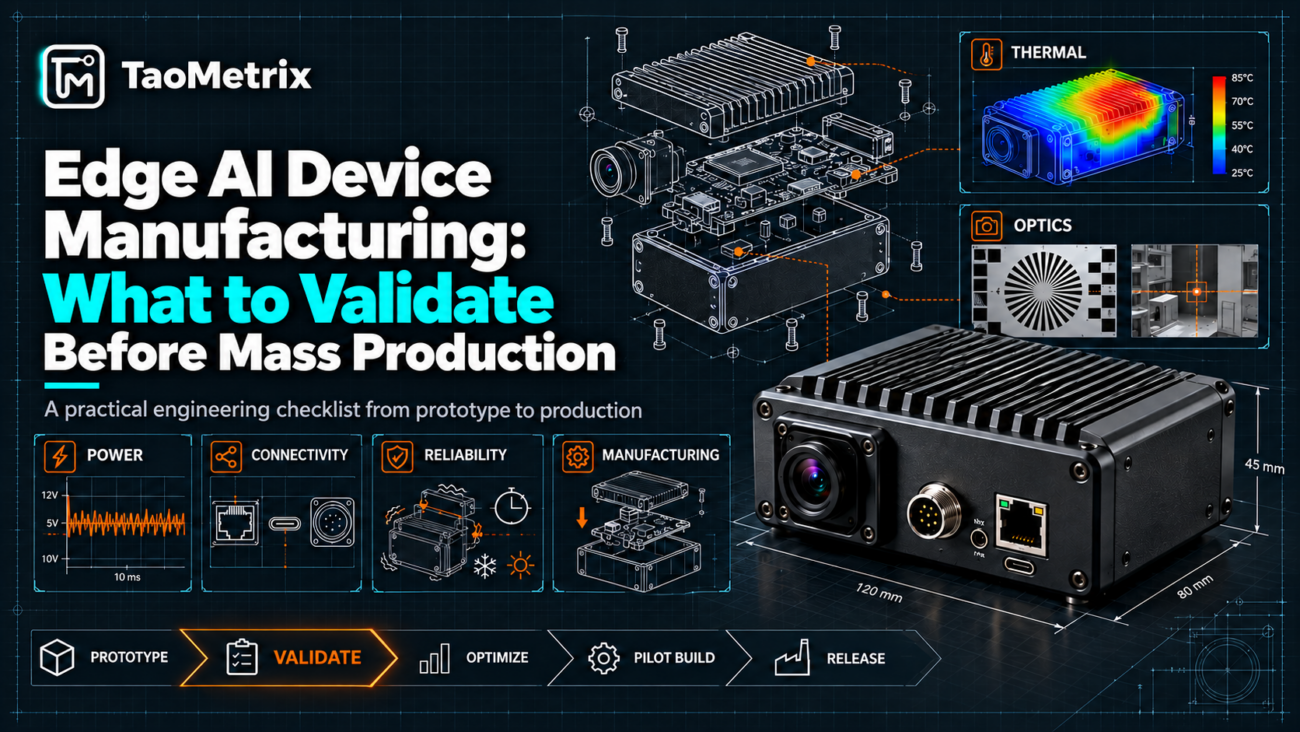
A prototype may perform well for a short demonstration but become unstable during continuous operation. Thermal testing should therefore be completed before mass production.
Power and Performance
AI computing performance is closely connected to power consumption. Product teams must balance:
- Processing performance
- Power draw
- Operating temperature
- Adapter or battery requirements
- Noise level
- Device size
- User expectations
The right balance depends on whether the product is designed for a desktop, portable, industrial, educational, or developer-focused use case.
Hardware and Software Integration
A local AI device is not just a computer enclosure. The final user experience also depends on:
- Operating system configuration
- AI model installation
- API compatibility
- Device management
- Storage allocation
- Firmware updates
- Model switching
- Technical documentation
Hardware and software teams should work together from the early engineering stage.
From Crowdfunding Prototype to Production
A successful crowdfunding campaign can validate customer interest, but it does not automatically mean that a product is ready for volume production.
Before manufacturing begins, an AI hardware startup should usually complete the following stages:
- Product requirements definition
- Computing platform selection
- Industrial and mechanical design
- PCB and electronic system development
- Thermal and power validation
- Engineering prototype testing
- Design-for-manufacturing review
- Produção-piloto
- Functional and reliability testing
- Production ramp-up
Pilot production is especially important because it reveals problems that may not appear in a prototype.
Typical pilot-production issues include:
- Cable interference
- Limited assembly clearance
- Difficult connector installation
- Inconsistent thermal contact
- Long testing cycles
- Unclear production instructions
- Component shortages
- Difficult failure analysis
How TaoMetrix Can Support AI Hardware Manufacturing
TaoMetrix supports AI hardware projects according to their product stage, design maturity, production volume, and target market.
Potential support areas include:
Engineering Review
TaoMetrix can review product requirements, target cost, expected volume, computing platform, enclosure constraints, power consumption, cooling requirements, and manufacturing risks.
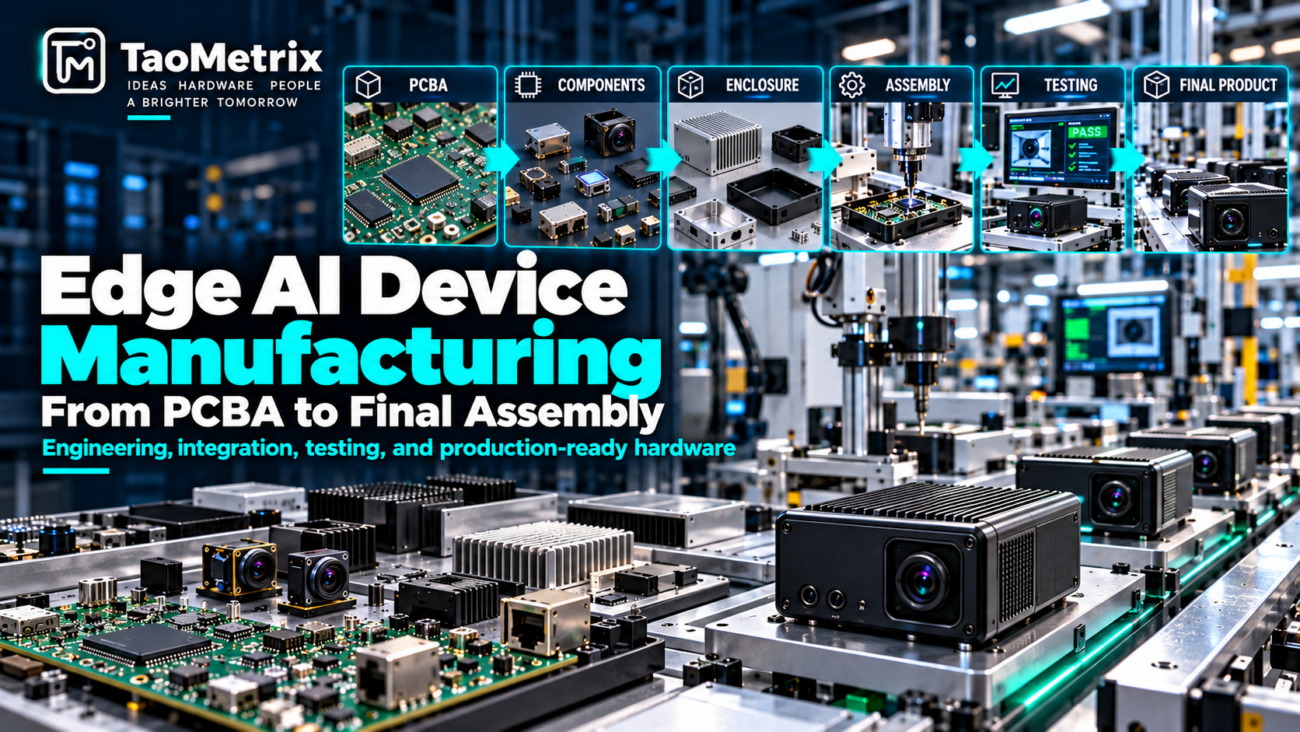
PCB Assembly and PCBA Integration
Manufacturing support may include PCB assembly, component placement, module integration, cable connection, firmware loading, and electrical inspection based on the customer’s design files.
Mechanical and Final Assembly
AI hardware products often require close coordination between the PCB, cooling system, enclosure, buttons, connectors, and mounting structure.
A manufacturing partner can help identify assembly risks before production begins.
Functional Testing
Depending on the project, testing may include:
- Power-on verification
- Interface testing
- Wireless connectivity
- Storage and memory checks
- Power consumption
- Temperature rise
- Long-duration operation
- Firmware and system validation
OEM, ODM, and Joint Development
Customers with completed designs may choose an OEM manufacturing model.
Customers that need support with engineering, component selection, production preparation, or product integration may consider ODM or joint development.
The appropriate model depends on the customer’s design files, internal engineering resources, expected quantity, target cost, certification needs, and launch schedule.
What Should Customers Ask an AI Hardware Manufacturer?
Before selecting an AI hardware manufacturing partner, customers should ask:
- Does the manufacturer have experience with complex electronic devices?
- Can it support high-power products and thermal structures?
- Does it provide engineering samples and pilot production?
- Can it manage PCBA and final assembly?
- Are functional and reliability tests clearly defined?
- Can it maintain BOM and engineering-change records?
- Can it support firmware loading and device configuration?
- Are OEM, ODM, and joint-development responsibilities clear?
- Can it protect design files through an NDA?
- Can it provide measurable pilot-production results?
The lowest quotation is not always the lowest overall project cost. Engineering communication, test coverage, defect control, and production repeatability can have a greater impact on the final result.
Three Lessons for AI Hardware Startups
1. Validate the User Need
Crowdfunding can help a startup understand whether users are willing to pay for a product, not just whether they find the concept interesting.
2. Turn Product Claims Into Measurable Results
Statements such as “local AI,” “portable computing,” and “zero token fees” should be supported by practical information about performance, response time, power consumption, temperature, supported models, and software usability.
3. Plan Manufacturing Before Launch
Manufacturing should be considered before the crowdfunding campaign begins. Component availability, testing, packaging, fulfillment, warranty support, and production capacity can all affect the customer experience.
Conclusão
Tiiny AI Pocket Lab reflects the growing demand for local AI computers and edge AI devices. It also demonstrates that AI hardware manufacturing requires much more than selecting a processor and placing it inside an enclosure.
A production-ready AI device requires coordinated work across:
- Computing hardware
- PCB assembly
- Thermal management
- Power design
- Mechanical engineering
- Firmware
- Testes funcionais
- Supply-chain planning
- Montagem final
For teams developing local AI computers, edge AI terminals, developer devices, or similar products, TaoMetrix can support engineering review, PCBA assembly, final assembly, testing, and pilot production based on project requirements.
Customers can begin an engineering discussion by preparing:
- Product requirements
- Target users and use cases
- Computing platform
- Product dimensions
- Power and cooling requirements
- BOM, PCB, CAD files, or reference samples
- Expected production volume
- Target sales markets
- Certification and delivery requirements
With this information, the product’s engineering feasibility, manufacturing path, and production-readiness can be evaluated more accurately.