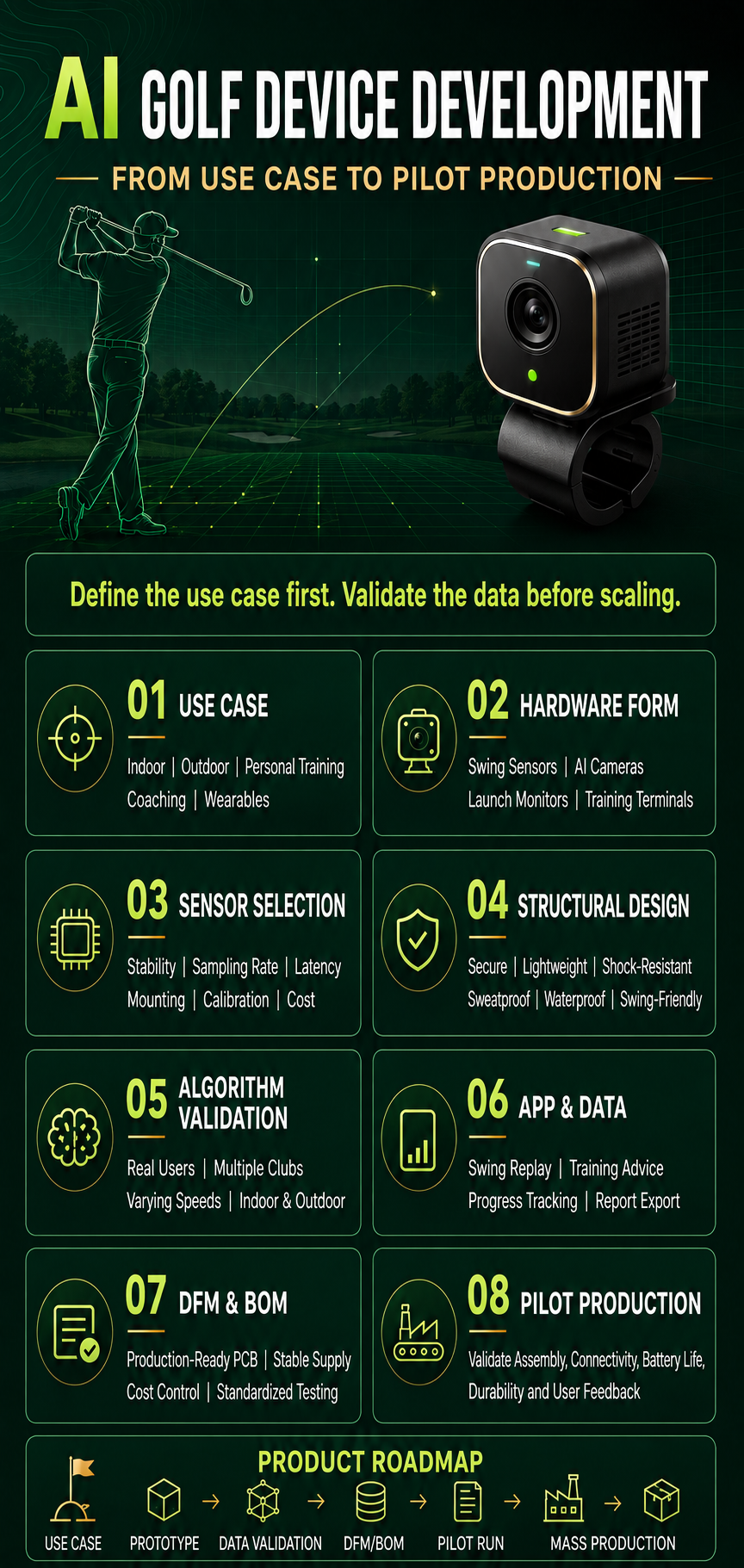
TaoMetrix: Разработка устройств для гольфа на базе ИИ — это не только алгоритмы


AI golf devices are becoming a strong niche in sports technology.
They can help users analyze swing motion, club path, impact angle, speed, rhythm, posture, ball flight, and training progress. For golf coaches, indoor golf studios, training centers, and individual players, the value is clear: turn training from experience-based judgment into measurable data.
But developing an AI golf device is not just building an app or adding a few sensors.
The real challenge is connecting the golf use case, sensors, algorithms, hardware design, power, connectivity, testing, and production.
1. Start with the Real Golf Use Case
The first step is not choosing a sensor.
The first step is understanding where and how the product will be used.
Different use cases require different hardware decisions.
An indoor golf studio needs to consider camera angle, lighting, distance, and ball speed detection.
An outdoor golf course needs to consider sunlight, wind, rain, dust, waterproofing, and long-range connection.
A personal training device needs portability, battery life, fast setup, and a simple app experience.
A coach-focused device needs multi-user data management, swing replay, training reports, and stable operation.
A club-mounted or glove-mounted wearable needs low weight, comfort, sensor accuracy, and strong attachment.
If the use case is not clear, the product may become feature-rich but hard to use.
2. Choose the Right Hardware Form
AI golf devices can take many forms.
Common product types include:
Swing sensors
Club trackers
Smart golf gloves
AI golf cameras
Portable swing analyzers
Launch monitoring devices
Indoor golf training hardware
Ball speed and trajectory trackers
Posture analysis devices
Coach-side training terminals
Each form has different manufacturing challenges.
Camera-based devices depend on image quality, lens selection, edge processing, and mounting angle.
Wearable devices depend on weight, battery life, Bluetooth stability, and wearing comfort.
Club-mounted devices depend on shock resistance, attachment design, motion data accuracy, and durability.
Training terminals depend on display, interaction, enclosure, power supply, and long-term operation.
The hardware form should match the training scenario, not just the product idea.
3. More Sensors Do Not Always Mean Better Data
Common sensors for AI golf devices include IMU, accelerometer, gyroscope, magnetometer, camera, radar, microphone, pressure sensor, and GPS.
But more sensors do not automatically create a better product.
The team should check:
Is the data stable?
Is the sampling rate high enough?
Is the latency acceptable?
Is the sensor position correct?
Is setup and calibration easy?
Can it handle real swing speed?
Does the data support the AI model?
Is the cost suitable for production?
For example, if a swing sensor is not fixed firmly, the data may drift.
If a camera angle is wrong, motion analysis may be inaccurate.
If strong sunlight overexposes the image outdoors, AI recognition may fail.
Sensor selection should start from the real training environment, not only from a spec sheet.
4. Mechanical Design Can Affect Data Accuracy
Golf is a high-speed sport.
A swing happens quickly, and small movements matter. If the device moves, shifts, or changes the feel of the club, the data may become unreliable.
The hardware design should consider:
Is the device firmly attached?
Does it affect the swing?
Is the weight acceptable?
Is the enclosure shock-resistant?
Is it sweatproof, waterproof, or dustproof?
Are the buttons and indicators easy to understand?
Is charging convenient?
Can users carry and use it frequently?
For sports technology products, hardware should not interrupt the user’s movement.
A good AI golf device should feel almost invisible, while still collecting stable and reliable data.
5. The Algorithm Must Be Tested with Real Hardware Data
Many teams start with a software demo using phone video or lab data.
That is useful for early validation.
But once the product moves toward hardware development, the algorithm must be tested with real device data.
Teams should test:
Different body types and swing habits
Different golf clubs
Different swing speeds
Indoor and outdoor lighting changes
Camera angle changes
Sensor attachment tightness
Bluetooth stability
Data sync latency
Long training sessions
Data consistency over time
If the algorithm only works in ideal conditions, the product will struggle in the real market.
6. The App Experience Decides Whether Users Keep Using It
An AI golf device should not only collect data.
Users care about one question:
Can this help me improve?
The app or software experience should make the data easy to understand.
Useful features may include:
Swing replay
Key metric tracking
Training suggestions
Historical comparison
Coach comments
Motion error alerts
Training plans
Multi-device connection
Report export
The hardware collects data.
AI explains the data.
The app presents the result.
All three need to work together to create long-term value.
7. DFM and BOM Review Should Start Before Production
Early AI golf prototypes may use development boards, 3D-printed parts, and temporary sensors.
That is normal.
But before production, the team needs to review:
Is the PCB ready for SMT production?
Is the enclosure suitable for manufacturing?
Are the sensors available at scale?
Is the BOM cost aligned with the target price?
Are battery size and capacity reasonable?
Are Bluetooth, Wi-Fi, or data interfaces stable?
Can the testing process be standardized?
Is the packaging suitable for sports consumer products?
For wearables or club-mounted devices, teams should also test drop resistance, vibration, sweat exposure, temperature, and long-term wear.
8. Pilot Production Is Better Than Jumping Straight to Volume
AI golf devices should not go directly from prototype to large-volume production.
A safer path is pilot production.
Pilot production helps validate:
Assembly process
Sensor installation consistency
Functional testing
Bluetooth stability
Battery life
Enclosure durability
Packaging quality
User trial feedback
The goal is not to ship quickly.
The goal is to find problems before scaling.
This matters especially for sports hardware, because many issues only appear after real users train with the product repeatedly.
9. How TaoMetrix Supports AI Golf Device Development
TaoMetrix is based in Shenzhen, China, and focuses on AI hardware product development and manufacturing support.
We help AI golf device teams with:
Product solution review
Sensor and chip platform selection
Производство печатных плат и поверхностного монтажа
Mechanical and enclosure optimization
Оптимизация стоимости спецификации
Final assembly
Functional testing
Пробное производство
OEM / ODM manufacturing
Поддержка в вопросах упаковки и доставки
TaoMetrix has 20+ years of electronics manufacturing experience, a 20,000㎡ manufacturing facility, 12 SMT production lines, 6 DIP production lines, and 4 final assembly lines.
We help sports technology teams move AI golf devices from prototype to production.
Заключение
AI golf device development is not just putting an algorithm into a hardware shell.
It needs to start from real swing scenarios and connect sensors, mechanical design, algorithms, connectivity, battery life, testing, packaging, and production.
A useful AI golf device should not only generate impressive data once.
It should provide stable, trustworthy, and easy-to-understand feedback in real training.
TaoMetrix helps global AI hardware teams use Shenzhen’s supply chain to move AI golf devices from concept and prototype to pilot production and OEM/ODM manufacturing.