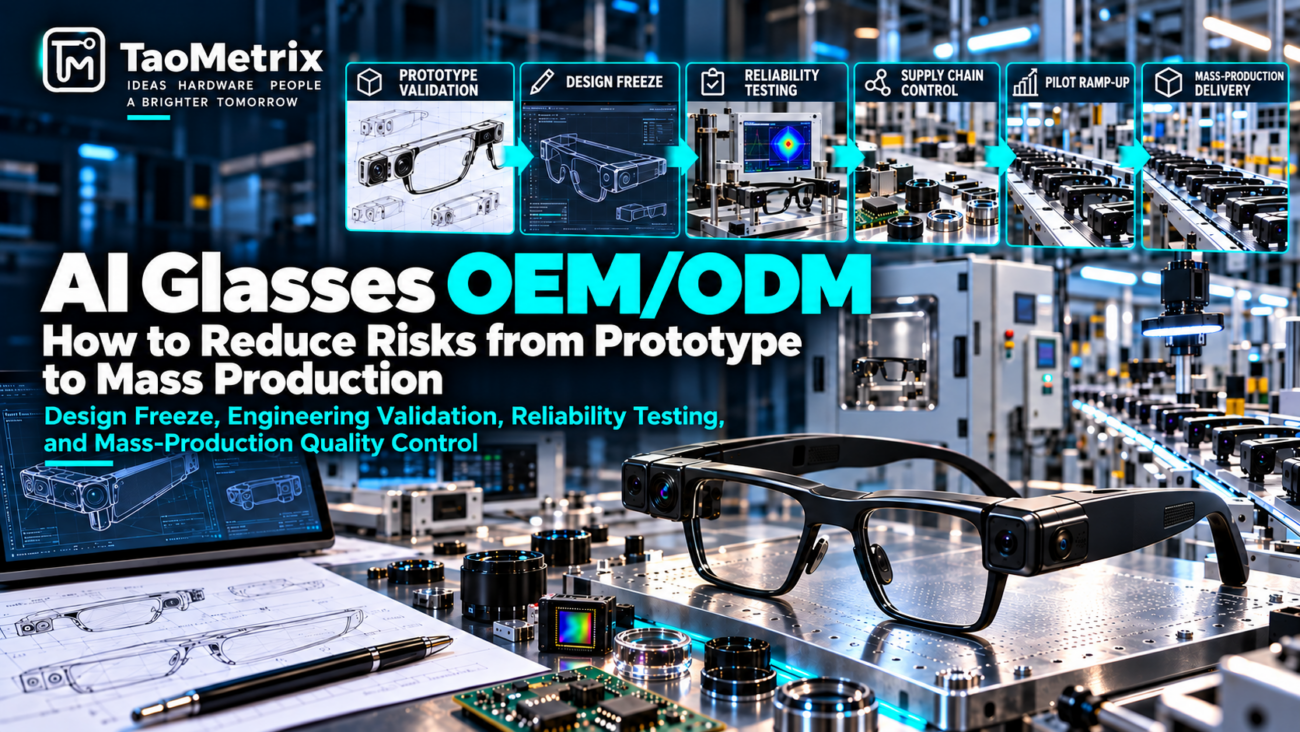
Choosing the right AI glasses OEM/ODM partner is an important decision for brands, startups, and product teams developing smart eyewear.
AI glasses are not simply traditional glasses with an AI module added. A production-ready product may need to integrate cameras, microphones, speakers, batteries, wireless connectivity, flexible PCBs, firmware, mobile applications, and optical or mechanical components inside a compact frame.
For this reason, customers need more than a basic assembly factory. They need a manufacturing partner that can support engineering development, prototype validation, design-for-manufacturing review, pilot production, testing, and mass-production introduction.
What Is AI Glasses OEM/ODM?
AI glasses OEM/ODM generally includes two cooperation models: OEM manufacturing and ODM support.
AI Glasses OEM
OEM is suitable for customers with a mature product design and complete manufacturing documentation.
The customer usually provides:
- Product specifications
- Bill of materials
- PCB or Gerber files
- CAD files
- Firmware and programming requirements
- Functional test standards
- Требования к упаковке
- Delivery requirements
The manufacturer may then support:
- Component sourcing
- PCB and PCBA assembly
- Module installation
- Final assembly
- Firmware loading
- Functional testing
- Packaging and delivery
AI Glasses ODM
ODM is suitable for customers that need additional engineering and product-integration support.
The customer may provide:
- Product positioning
- Target users
- Core functions
- Industrial-design direction
- Expected production volume
- Target cost
- Target markets
Depending on the project scope, an ODM partner may support:
- Hardware-platform evaluation
- Camera, microphone, and speaker selection
- Mechanical and electronic integration
- Battery and power-system coordination
- Prototype development
- DFM review
- Пробное производство
- Manufacturing preparation
OEM and ODM are not competing choices. The right model depends on the maturity of the product and the engineering resources available inside the customer’s team.
Why Are AI Glasses Difficult to Manufacture?
AI glasses must integrate multiple systems into a lightweight wearable product.
A pair of AI glasses may include:
- A main processor or AI platform
- Модули камер
- Microphone arrays
- Speakers or directional audio
- Battery and charging systems
- Bluetooth, Wi-Fi, or other wireless modules
- Flexible PCBs
- Frames, temples, lenses, and hinges
- Firmware and mobile applications
- Cloud-based or local AI services
These components are closely connected.
Например:
- Camera placement affects the frame structure.
- Microphone placement affects voice recognition and noise reduction.
- Speaker placement affects sound quality and audio leakage.
- Battery capacity affects product weight and operating time.
- Processor performance affects power consumption and heat.
- Antenna placement affects wireless connectivity.
- Temple space limits the size of the PCBA and battery.
AI glasses manufacturing therefore requires coordination across electronics, mechanical engineering, acoustics, thermal management, power design, and software.
What Stages Are Included in an AI Glasses OEM/ODM Project?
1. Product Requirements and Feasibility Review
At the beginning of the project, the customer and manufacturer should clarify:
- Whether the product targets consumers or enterprise users
- Whether cameras are required
- Whether displays are required
- Whether real-time translation is supported
- Whether the product depends on a mobile phone or cloud service
- Target product weight
- Target battery life
- Water or dust-resistance requirements
- Target sales markets
- Current project stage
Clear requirements help the team evaluate the hardware platform, available space, power consumption, components, testing requirements, and manufacturing risks.
2. Electronic and Mechanical Integration
Electronic and mechanical development should move forward together.
An engineering review may cover:
- Main processor and AI platform
- Cameras, microphones, and speakers
- Battery, power management, and charging
- Bluetooth, Wi-Fi, and antennas
- Flexible PCBA
- Internal frame and temple space
- Thermal management
- Wearing comfort
- Firmware and mobile-app connectivity
If electronics and mechanical engineering are not coordinated early, the project may later face insufficient space, cable interference, poor component fixation, or difficult assembly.
3. Engineering Prototype Development
An engineering prototype should verify more than whether the product can power on.
Typical prototype validation may include:
- Camera image quality
- Voice activation
- Microphone recording
- Noise reduction
- Speaker output
- Audio leakage
- Bluetooth stability
- Battery life
- Charging safety
- Operating temperature
- Frame and temple strength
- Firmware and mobile-app interaction
- Long-duration wearing comfort
The purpose of prototype testing is to identify product and manufacturing risks before pilot production.
4. Design-for-Manufacturing Review
When the design becomes more stable, the team should conduct a DFM review.
DFM review may examine:
- Component availability
- Compatibility between electronic and mechanical parts
- Connector installation
- Cable routing and durability
- Camera and microphone alignment
- Temple assembly risks
- Tooling and fixture requirements
- Testing procedures
- Dimensional tolerances
- Appearance standards
- Repeatability of the assembly process
A DFM review helps reduce assembly problems, rework, quality issues, and unexpected production costs.
5. Pilot Production
Pilot production is the transition between engineering prototypes and mass production.
It helps verify:
- Assembly yield
- Critical-dimension consistency
- Camera and microphone positioning
- Battery and cable installation
- Functional-test time
- Appearance quality
- Material availability
- Production SOPs
- Rework and repair procedures
Some products work correctly during prototype testing but encounter problems during pilot production, including:
- Insufficient assembly clearance
- Cable interference
- Difficult screw installation
- Unstable battery mounting
- Camera-position deviations
- Inconsistent enclosure gaps
- Excessive testing time
- Unclear rework procedures
Pilot production should therefore be treated as part of product validation.
6. Mass-Production Introduction
Before mass production begins, the customer and manufacturer should confirm:
- Final BOM revision
- Approved component alternatives
- Production SOPs
- Functional test standards
- Appearance-inspection standards
- Firmware version
- Packaging configuration
- Production batches
- Quality responsibilities
- Delivery schedule
The goal is to maintain consistent quality across different production batches.
How Should Customers Choose an AI Glasses OEM/ODM Partner?
Does the manufacturer have wearable-electronics experience?
AI glasses have specific requirements related to size, weight, mechanical structure, audio, wireless connectivity, and batteries.
Customers should ask whether the supplier has experience with compact wearable electronics or similar integrated products.
Does the supplier support prototypes and pilot production?
A manufacturer that only accepts mass-production orders may not be suitable for a startup that still needs design validation.
Prototype and pilot-production support can help customers identify problems before committing to larger production volumes.
Can the supplier integrate cameras, audio, and wireless modules?
The user experience of AI glasses depends heavily on camera quality, microphones, speakers, Bluetooth, and other wireless connections.
The manufacturing partner should be able to support module installation and functional validation.
Does the supplier have PCBA and flexible-PCB capabilities?
AI glasses have limited internal space. Flexible PCBs and miniature PCBAs are often necessary to fit the electronic system inside the temples and frame.
Customers should confirm whether the manufacturer has the required assembly and testing capabilities.
Can the supplier perform DFM reviews?
A capable AI glasses OEM/ODM partner should identify space, assembly, component, testing, and supply-chain risks before production.
The manufacturer should contribute engineering feedback rather than only follow drawings.
Are testing procedures clearly defined?
Customers should ask whether the supplier can test:
- Power-on function
- Camera performance
- Microphone and speaker performance
- Bluetooth connectivity
- Charging
- Battery behavior
- Power consumption
- Temperature rise
- Firmware loading
- Long-duration operation
The final testing plan should be based on the product specification and target market.
Can the supplier protect customer information?
Before sharing BOMs, CAD files, PCB files, firmware, and samples, customers should use an NDA and a written project agreement.
The agreement should clarify confidentiality, intellectual property, tooling, samples, and engineering changes.
How TaoMetrix Can Support AI Glasses Projects
TaoMetrix can discuss AI glasses OEM/ODM support according to the customer’s product stage, design files, expected production volume, and target market.
Potential support areas include:
- Product-requirements review
- Hardware and mechanical engineering review
- PCB and PCBA assembly
- Camera, microphone, and speaker integration
- Battery and charging-system assembly
- Wireless-module integration
- Frame and temple assembly
- Firmware loading
- Power, interface, and connectivity testing
- Appearance and assembly inspection
- Engineering prototypes
- DFM review
- Пробное производство
- OEM manufacturing
- ODM support
- Координация упаковки и доставки
The actual manufacturing scope, cost, lead time, and certification requirements should be evaluated according to the product design, expected volume, target market, and test standards.
What Information Should Customers Prepare?
To improve project evaluation, customers should prepare:
- Product positioning
- Target users
- Core use cases
- AI-function requirements
- Camera requirements
- Display requirements
- Target product weight
- Target battery life
- Product dimensions
- BOM
- PCB or Gerber files
- CAD files
- Firmware or mobile-app requirements
- Reference samples
- Expected production volume
- Target cost
- Target sales markets
- Certification and delivery requirements
The more complete the information, the more accurately the manufacturing partner can evaluate engineering feasibility and production requirements.
Часто задаваемые вопросы
What is the difference between AI glasses OEM and ODM?
With OEM, the customer usually provides a mature design and complete production documents. The manufacturer focuses on production, testing, assembly, and delivery.
With ODM, the manufacturer may also support hardware selection, mechanical integration, prototypes, DFM, pilot production, and manufacturing introduction.
What is the MOQ for AI glasses manufacturing?
The minimum order quantity depends on the product design, components, tooling, testing requirements, and configuration.
A fixed MOQ should not be confirmed before the project details have been reviewed.
Can AI glasses move directly from prototype to mass production?
Directly moving from a small number of prototypes to mass production is generally not recommended.
A safer process is to complete engineering prototypes, pilot production, functional validation, and production-readiness review before scaling up.
Do AI glasses require tooling?
If the customer needs a customized frame, temple, enclosure, or mechanical structure, tooling requirements should be evaluated.
The actual requirement depends on the design, materials, production volume, and target finish.
What tests are required for AI glasses?
Common tests include cameras, microphones, speakers, Bluetooth, charging, batteries, power consumption, temperature rise, firmware, mechanical strength, and long-duration operation.
The final test plan depends on product specifications and target-market requirements.
How can I protect my AI glasses design?
Sign an NDA before sharing core design files and samples.
The project agreement should also clarify intellectual property, tooling, samples, BOMs, firmware, and engineering-change ownership.
Заключение
The core of an AI glasses OEM/ODM project is not simply finding a factory that can assemble eyewear. It is finding a manufacturing partner that understands compact electronics, mechanical design, acoustics, power consumption, wireless connectivity, and production engineering.
From product concept to final delivery, an AI glasses project typically involves:
- Product-requirements review
- Electronic and mechanical integration
- Engineering prototype development
- Functional and reliability testing
- DFM review
- Пробное производство
- Mass-production introduction
TaoMetrix can discuss engineering review, PCBA assembly, final assembly, functional testing, pilot production, OEM, and ODM manufacturing for AI glasses projects based on the customer’s requirements and project stage.
If you are developing AI glasses, prepare your product requirements, design files, expected production volume, and target market information to begin evaluating the right manufacturing path.