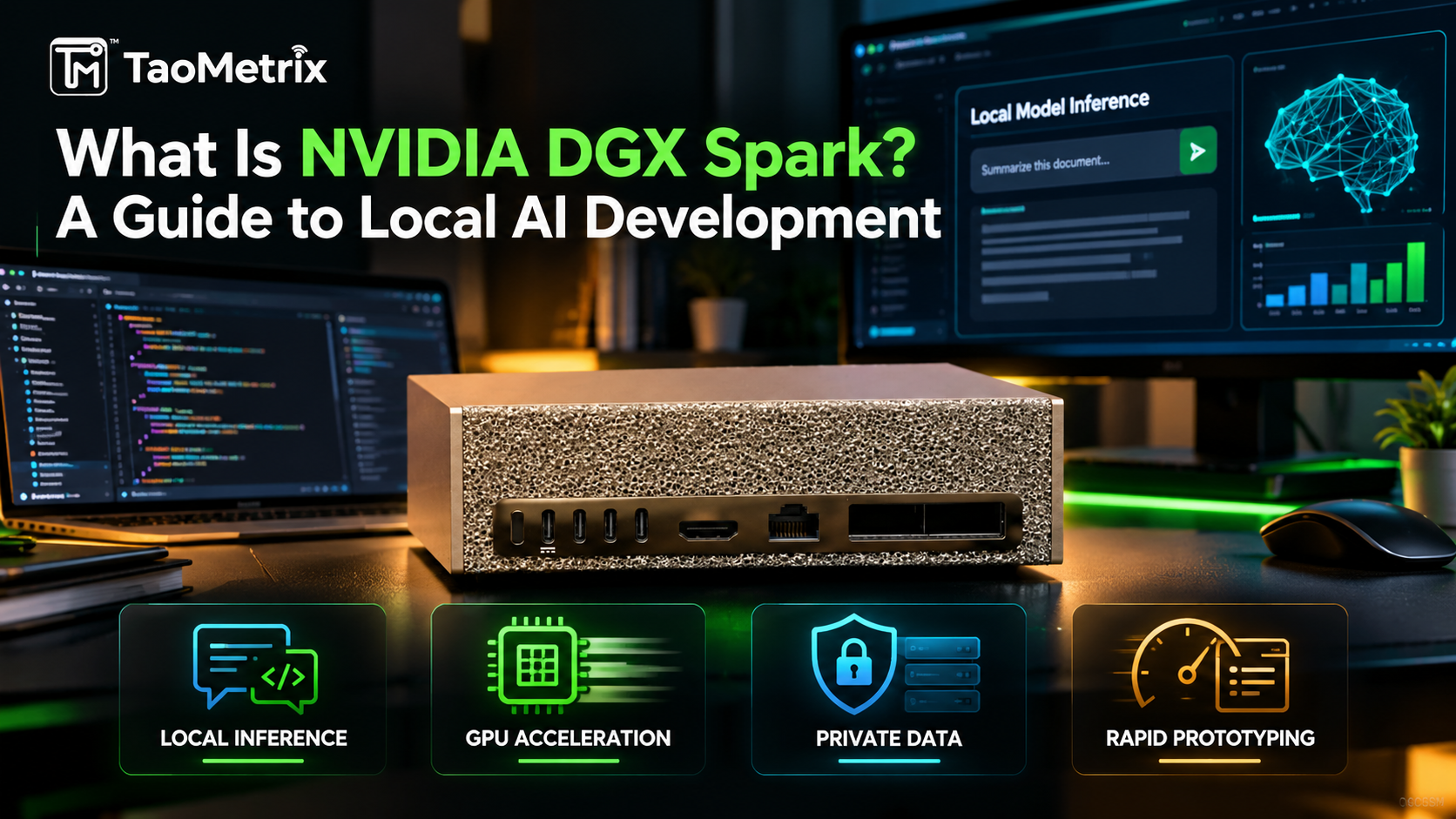
NVIDIA DGX Spark is a compact local AI computing system designed for developers, researchers, and enterprise AI teams. Built around the NVIDIA Grace Blackwell architecture and GB10 Superchip, it is designed to support AI model development, fine-tuning, inference, and deployment on a desktop.
For companies developing AI products, the value of DGX Spark is not only its compact form factor or computing capability. It also provides a local development environment that is closely connected to NVIDIA’s AI software ecosystem.
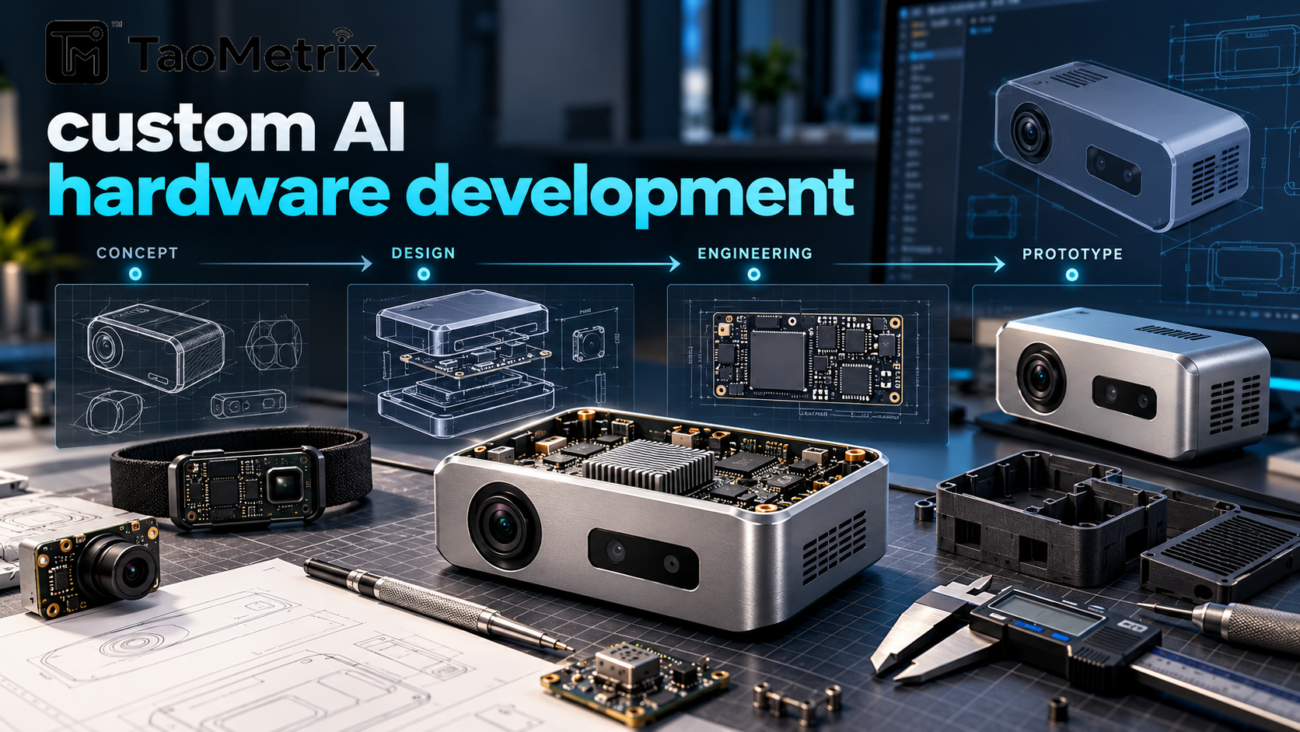
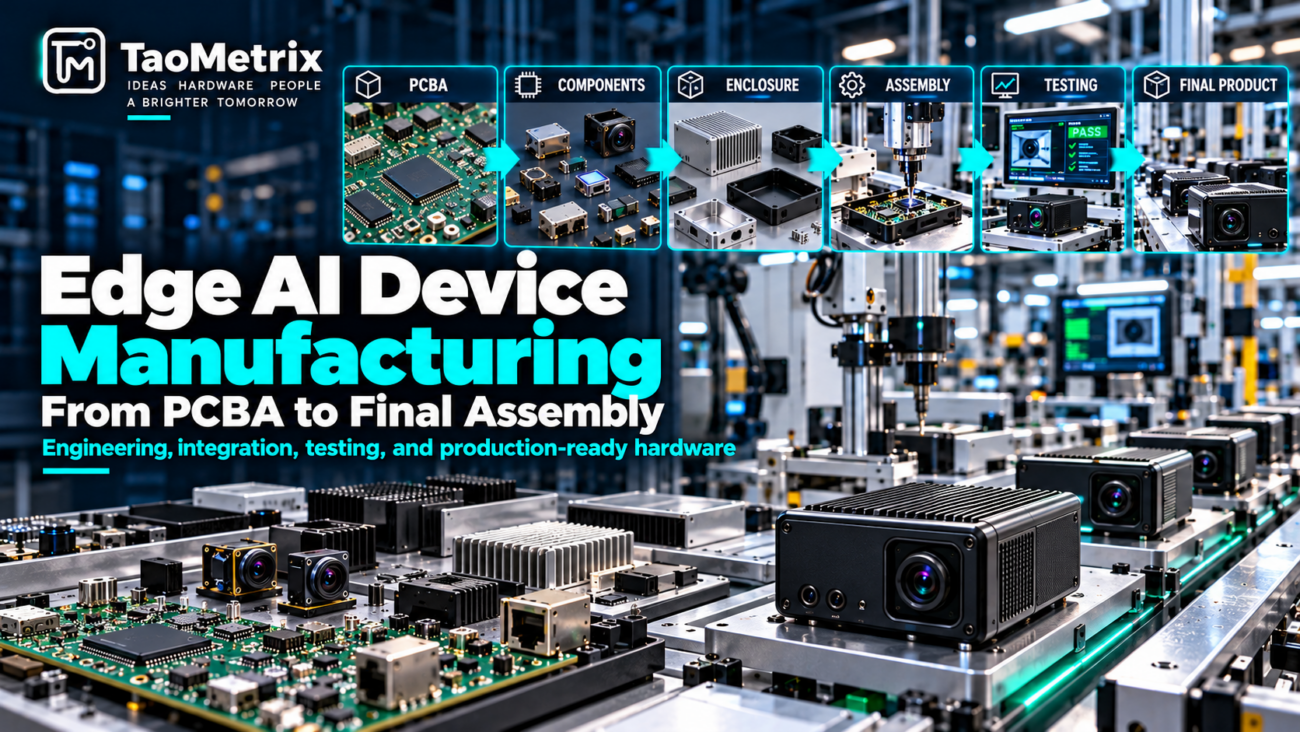
However, DGX Spark is not automatically the final product for every commercial AI project. It is better understood as a development, validation, and local inference platform. Companies that want to integrate AI into cameras, robots, industrial terminals, or custom AI boxes still need hardware engineering, interface design, thermal validation, testing, and manufacturing.
TaoMetrix supports companies from AI hardware concept and engineering validation to OEM/ODM production.
What Is NVIDIA DGX Spark?
NVIDIA positions DGX Spark as a personal AI supercomputer for developers, data scientists, and researchers. According to NVIDIA’s official specifications, the platform uses the Grace Blackwell architecture, a 20-core Arm CPU, a Blackwell GPU, fifth-generation Tensor Cores, and up to 1 PFLOP of FP4 AI performance. It uses coherent unified memory shared by the CPU and GPU, with official configurations including 64GB and 128GB options and storage of up to 4TB NVMe.NVIDIA official specifications
Key features include:
- Grace Blackwell architecture
- NVIDIA GB10 Superchip
- 20-core Arm CPU
- Blackwell GPU
- Fifth-generation Tensor Cores
- Coherent unified memory
- NVMe storage
- 10GbE networking
- ConnectX-7 networking
- Wi-Fi 7
- USB Type-C connectivity
- NVIDIA DGX OS
Configurations, pricing, and availability may change. Buyers should confirm the latest information through NVIDIA and authorized sales channels.
Who Is DGX Spark Designed For?
AI Model Developers
Developers can use DGX Spark for:
- Model inference
- Parameter testing
- Model quantization
- Application development
- CUDA development
- Multimodal AI experiments
- AI agent development
A local device can reduce the need for frequent cloud GPU rentals and make testing more convenient.
AI Startups
For an AI startup, DGX Spark can be used to:
- Validate a product idea
- Test model performance
- Develop local AI applications
- Prepare a customer demo
- Evaluate an edge deployment strategy
- Support an early pilot project
However, a development system and a commercial product have different requirements. The company will later need to reassess cost, size, power consumption, interfaces, and supply-chain needs.
Enterprise AI Teams
Enterprise teams can use DGX Spark for:
- Private model testing
- Knowledge-base experiments
- Local inference
- Vision model validation
- Speech model development
- AI agent workflows
- Sensitive-data applications
For businesses that do not want to send raw data to the cloud, local AI development can provide greater control over the development environment.
What AI Workloads Can Run on DGX Spark?
Large Language Models
DGX Spark can be used to develop and test optimized language models for:
- Conversational AI
- Enterprise knowledge systems
- Local question answering
- Document retrieval
- AI agents
- Coding assistants
Whether a model can run depends on more than parameter count. Quantization, context length, memory usage, and inference software are also important.
Computer Vision
Potential vision applications include:
- Object detection
- Image classification
- Defect detection
- OCR
- Face detection
- Pose estimation
- Video analytics
- Visual question answering
If the final product will run on an industrial camera, robot, or edge AI box, the model must be tested again on the target hardware.
Vision-Language Models
Vision-language models combine image understanding with language reasoning. Possible applications include:
- Image question answering
- Scene descriptions
- Visual search
- Intelligent surveillance
- Equipment-status explanation
- Multimodal assistants
These workloads may require careful memory planning, software compatibility testing, and inference optimization.
Speech and Audio AI
DGX Spark can also support development of:
- Speech recognition
- Text-to-speech
- Voice assistants
- Meeting transcription
- Wake-word detection
- Multilingual voice applications
When moving the application into a commercial terminal, the team must also consider microphones, speakers, power, networking, and real-time response.
DGX Spark vs. a Custom Edge AI Device
DGX Spark is primarily a development and local computing platform. A custom edge AI device is designed for deployment in a specific environment.
| Evaluation Area | DGX Spark | Custom Edge AI Device |
|---|
| Main purpose | AI development and validation | Field deployment and product delivery |
| Design priority | Local AI capability | Stable operation for a defined task |
| Interfaces | General-purpose interfaces | Application-specific interfaces |
| Enclosure | Standardized product | Customized for installation |
| Thermal design | Desktop-oriented | Adapted to the operating environment |
| Software | Development environment | Firmware, application, and remote maintenance |
| التصنيع | Standard product | OEM/ODM production |
| Supply chain | Channel procurement | Long-term BOM and production management |
DGX Spark can be an excellent development platform, but it may not be the right final device for an industrial or embedded product.
Is DGX Spark Suitable for Industrial Vision?
DGX Spark can be used to develop and validate industrial vision models, including:
- Defect detection
- Object recognition
- OCR
- Video analytics
- Multimodal inspection
- Production-data analysis
A production industrial vision system also needs:
- Industrial cameras
- Lenses and lighting
- Trigger signals
- PLC communication
- Production-line cycle time
- Ambient-temperature validation
- Dust and vibration considerations
- Long-duration operation
- Data logging
- Failure recovery
A model that performs well on DGX Spark does not automatically run well on RK3588, Jetson, or a custom industrial AI box. The model may require conversion, quantization, and validation on the target platform.
How Do Companies Move from DGX Spark to a Product?
Step 1: Validate the AI Model
First, confirm:
- Whether the model meets the business requirement
- Whether accuracy is acceptable
- Whether response time is sufficient
- Whether the data pipeline works
- Whether fine-tuning is required
- Whether local deployment is practical
Step 2: Define the Product Form
The final product may be:
- An industrial AI box
- A robotics controller
- A smart camera
- An AI gateway
- An intelligent terminal
- A vision inspection device
- A voice-enabled device
Step 3: Re-evaluate the Hardware Platform
Depending on the application, the target platform may be:
- NVIDIA Jetson
- Rockchip RK3588
- Rockchip RK3576
- An x86 edge computer
- An ARM industrial platform
- A custom AI accelerator module
Platform selection should consider the model, interfaces, power consumption, cost, supply, and production plan.
Step 4: Complete Hardware Engineering
The engineering process may include:
- Mainboard or carrier-board design
- PCBA development
- Camera and sensor integration
- Power design
- Thermal design
- Enclosure development
- Communication interfaces
- Firmware and system integration
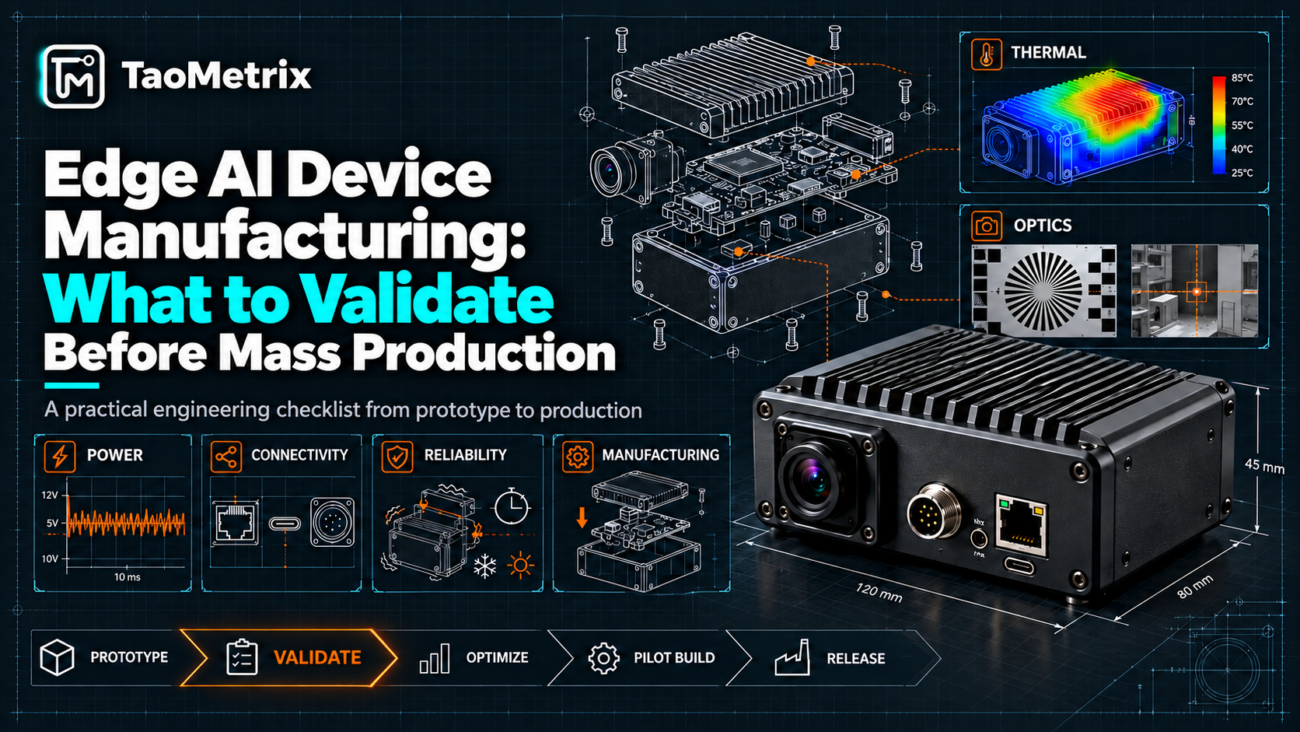
Step 5: Validate the Prototype and Production Process
Before volume manufacturing, the product should be tested for:
- Functionality
- AI performance
- Thermal stability
- Long-duration operation
- Network reliability
- Storage reliability
- Error recovery
- DFM readiness
- Pilot-production consistency
How TaoMetrix Supports DGX Spark-Related AI Hardware Projects
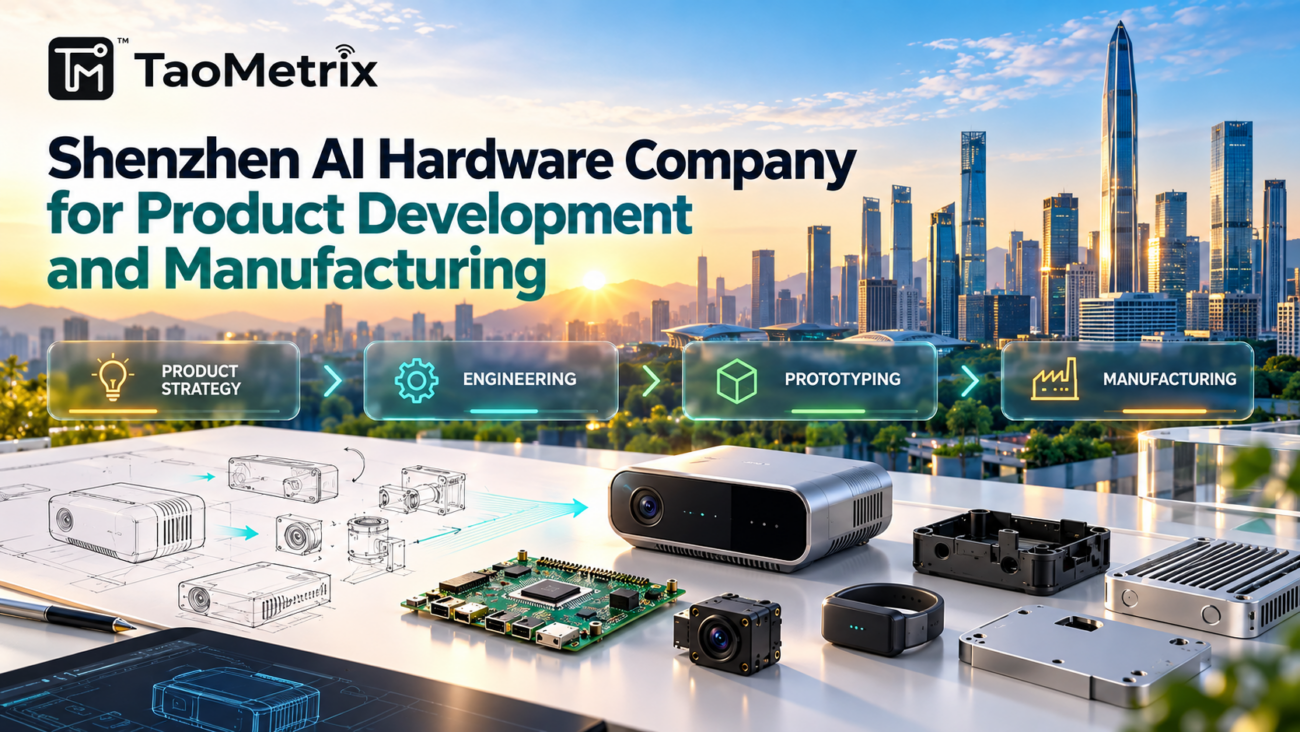
TaoMetrix helps customers move from an AI software requirement to a manufacturable hardware product.
Potential support includes:
- AI product requirement analysis
- Model deployment review
- Edge platform selection
- AI box development
- Custom PCBA
- Camera and sensor integration
- Power and thermal design coordination
- Firmware and system integration
- Engineering prototypes
- Functional and reliability testing
- DFM review
- Pilot production
- OEM/ODM final assembly
- Packaging and delivery coordination
The exact scope should be confirmed after reviewing the customer’s model, application, quantity, existing design, and delivery plan.
When Should You Not Choose DGX Spark?
DGX Spark may not be the best fit when a project requires:
- Extremely low unit cost
- Highly customized industrial interfaces
- Battery-powered operation
- Very small embedded form factors
- Strict BOM cost control
- Special ingress protection
- Large-scale enclosure customization
- Long-term dedicated component sourcing
This does not reduce the value of DGX Spark. It simply means that the platform is primarily suited to AI development and validation, while the final product may require a different hardware architecture.
What Should Customers Prepare Before Contacting TaoMetrix?
Prepare the following information where possible:
- AI application
- Current model
- Target deployment platform
- Camera or sensor quantity
- Target inference speed
- Input data type
- Product dimensions
- Power requirements
- Target market
- Prototype quantity
- Expected production quantity
- Existing development board or prototype
- Target delivery date
If complete technical documentation is not available, the product concept, model purpose, site photos, and target users are enough for an initial discussion.
Frequently Asked Questions
Is DGX Spark a server?
DGX Spark is better described as a compact personal AI computing system for AI development, inference, and model validation. It is not the same as a traditional rack-mounted data-center server.
Can DGX Spark train large AI models?
It can support model development, fine-tuning, and inference, but actual capability depends on the model, memory, software framework, and training method. Large-scale distributed training may still require a data-center GPU cluster.
Can DGX Spark be deployed directly in a factory?
It may be used as a reference or development platform, but factory deployment requires additional evaluation of protection, interfaces, temperature, mounting, power, software maintenance, and compliance.
Does TaoMetrix manufacture DGX Spark?
TaoMetrix should not be described as the official manufacturer of NVIDIA DGX Spark. TaoMetrix supports custom AI hardware, AI boxes, PCBA, and OEM/ODM products based on customer requirements.
What is the difference between DGX Spark and an RK3588 AI box?
DGX Spark is focused on high-performance local AI development and the NVIDIA CUDA ecosystem. An RK3588 AI box may be more suitable for customized interfaces, controlled power consumption, cost-sensitive deployments, and volume manufacturing. The right choice depends on the model and deployment environment.
Conclusion
NVIDIA DGX Spark lowers the barrier for local AI development, model testing, and application validation. It can help developers, researchers, and enterprise AI teams test models and build prototypes in a compact desktop environment.
However, moving from DGX Spark to a commercial hardware product still requires platform migration, interface design, thermal validation, firmware development, PCBA, testing, and production engineering.
TaoMetrix supports companies turning AI models and product ideas into manufacturable hardware, including custom development, engineering prototypes, PCBA, validation, pilot production, and OEM/ODM delivery.
Planning a local AI product? Share your model, application, interface requirements, target quantity, and product roadmap with TaoMetrix for an initial hardware-development review.
The product positioning and specifications in this article are based on NVIDIA’s official DGX Spark product page and user documentation. Configuration, pricing, availability, and software support may change, so buyers should confirm current information through NVIDIA. NVIDIA DGX Spark · DGX Spark Hardware Overview