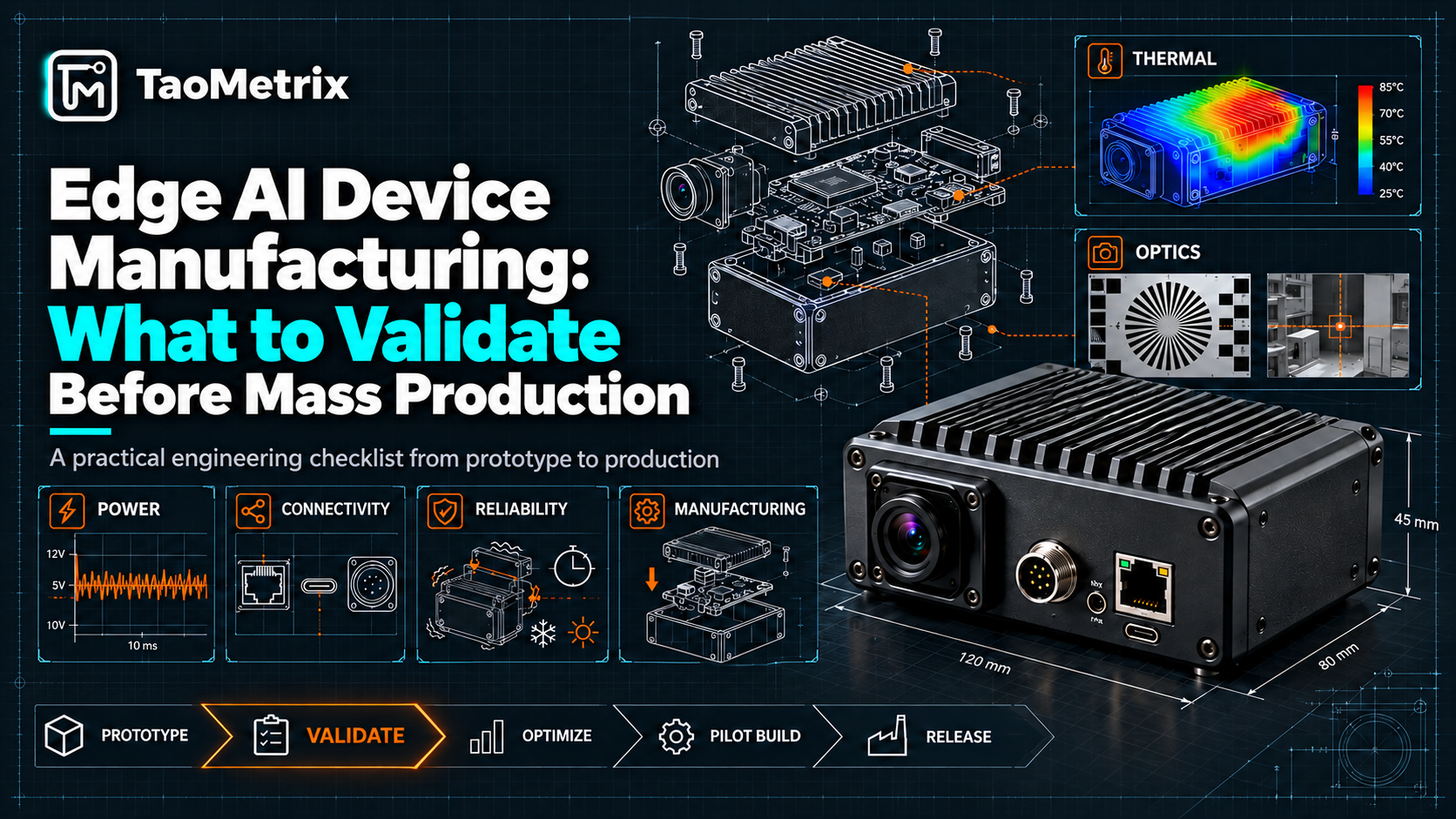
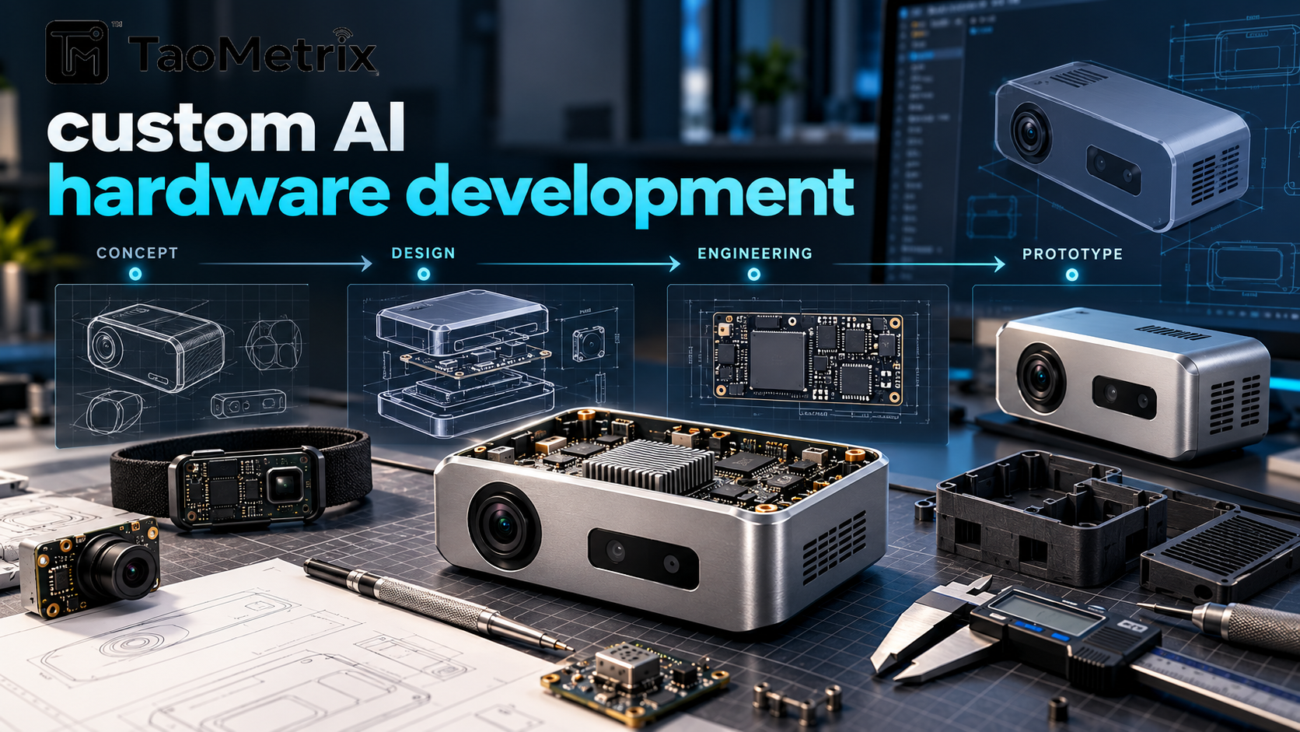
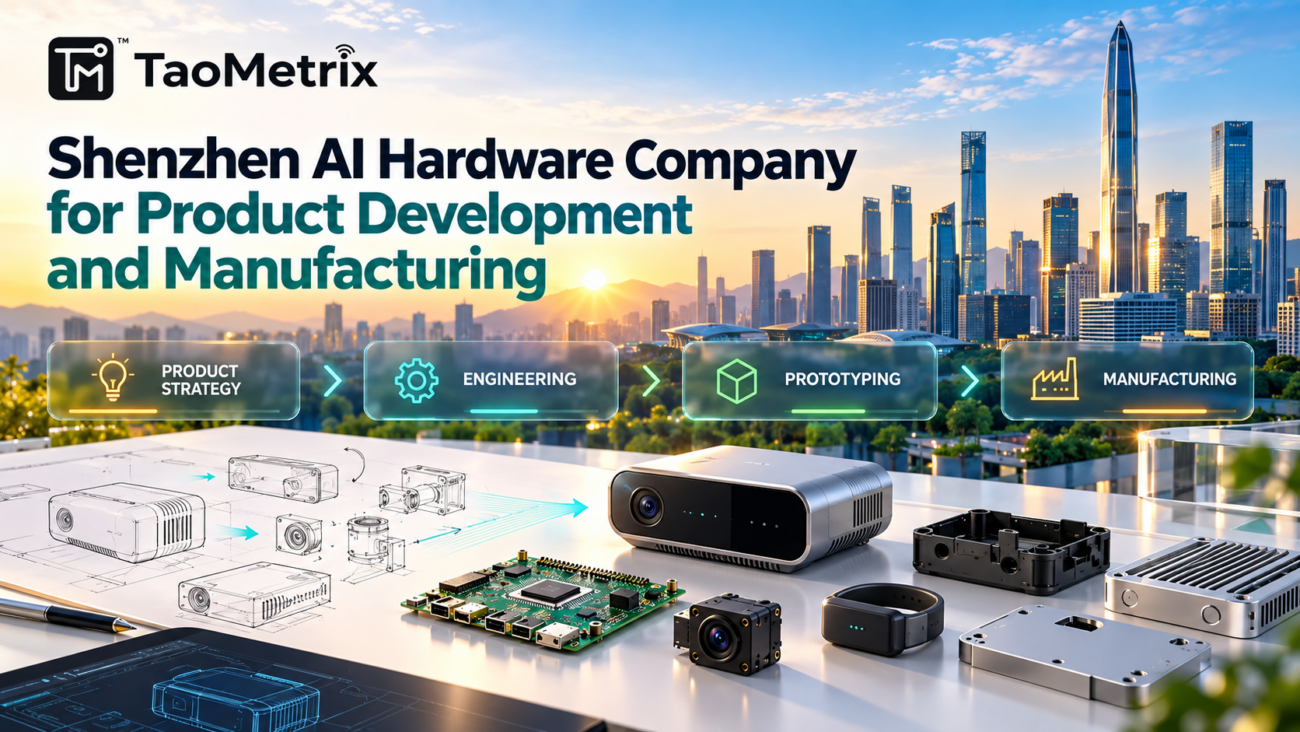
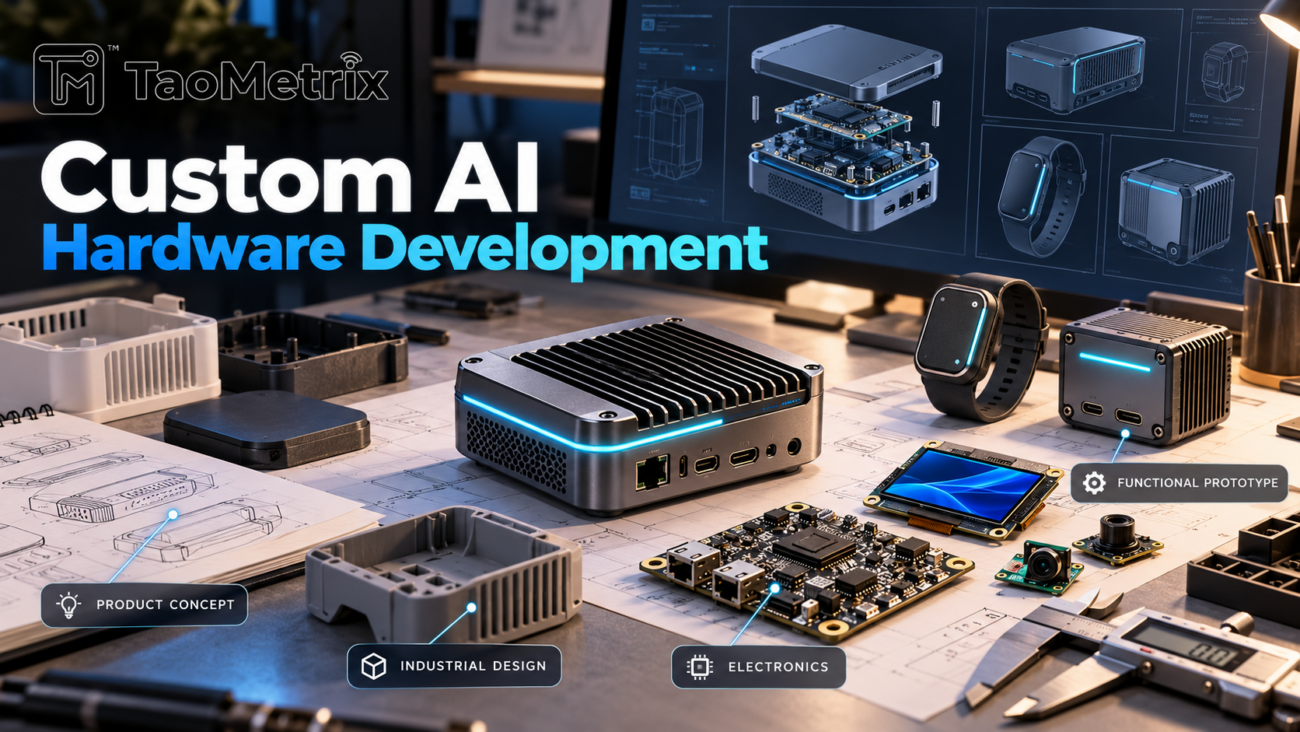
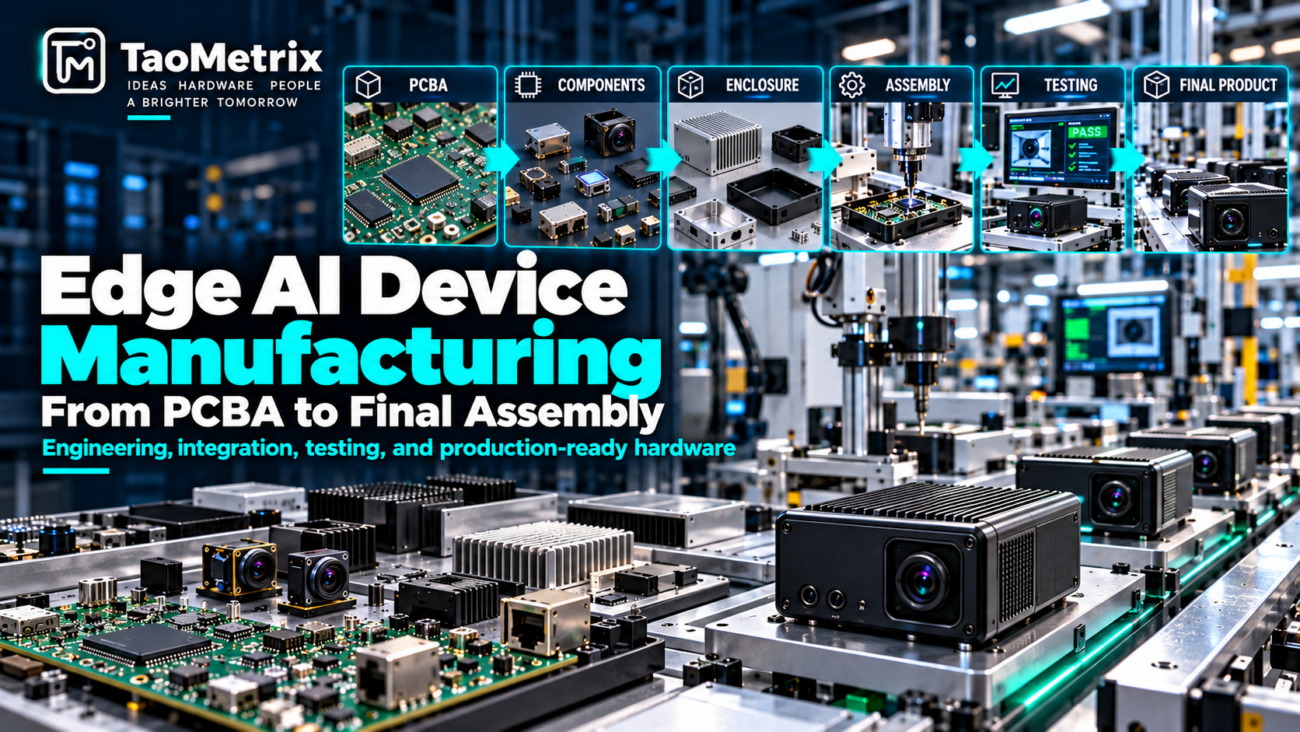
Edge AI device manufacturing requires more than assembling a PCBA inside an enclosure. Before mass production, customers need to validate computing performance, module integration, thermal behavior, power consumption, firmware, testing, DFM, DFT, and pilot-production readiness.
Edge AI devices are increasingly used in factories, warehouses, retail stores, robots, security systems, transportation, and smart-home environments. These products process data and perform AI inference close to where the data is generated.
This approach can reduce cloud dependence, lower response time, improve data privacy, and support applications that require reliable local intelligence.
What Is Edge AI Device Manufacturing?
Edge AI device manufacturing is the process of turning an AI-enabled hardware design into a complete product that can be assembled, tested, deployed, and produced consistently.
Typical edge AI devices include:
- AI cameras
- Industrial vision terminals
- Edge AI boxes
- Local AI computers
- Smart gateways
- Robotic vision modules
- AI development boards
- Smart retail terminals
- Vehicle vision devices
- Security and inspection systems
A reliable edge AI device manufacturing process connects PCBA assembly, computing-module integration, thermal management, firmware configuration, functional testing, pilot production, and final assembly.
Why Is Validation Important Before Mass Production?
An engineering prototype may work correctly in a controlled laboratory environment but still fail during production or field deployment.
Mass-produced edge AI devices may face:
- Continuous operating loads
- Network interruptions
- Temperature changes
- Dust and vibration
- Power fluctuations
- Component tolerances
- Assembly differences
- Software-version inconsistencies
Before mass production, the customer and manufacturer should confirm that the hardware, firmware, components, and production process work together reliably.
1. Validate the AI Computing Platform
The computing platform should match the actual application.
Customers should confirm:
- Whether the AI model can run on the target device
- Whether inference speed meets requirements
- Whether memory and storage are sufficient
- Whether the system supports continuous operation
- Whether power consumption is acceptable
- Whether cloud connectivity is required
- Whether the device can operate during network interruptions
- Whether future model updates are practical
A platform that performs well during a short demonstration may not be suitable for continuous AI workloads.
2. Validate PCBA and Module Integration
An edge AI device may combine a mainboard, AI computing module, camera, sensors, wireless module, and power system.
Before production, verify:
- Interface compatibility
- Stable power delivery
- Connector reliability
- Cable routing
- Camera and sensor positioning
- Wireless-signal performance
- PCBA mounting
- Approved component alternatives
PCBA problems can affect system startup, AI inference, wireless connectivity, and long-duration operation.
A qualified manufacturing partner should be able to manage BOM revisions, component substitutions, soldering quality, and test records.
3. Validate Thermal Performance and Power Consumption
Many edge AI devices operate for long periods, making thermal and power management essential.
Recommended tests include:
- Standby power
- Normal operating power
- Peak power
- Temperature during continuous inference
- Fan operation
- Enclosure temperature
- High-temperature operation
- Long-duration load
- Power recovery
- Restart after abnormal shutdown
If performance declines during extended operation, the cooling solution or computing platform may need to be reviewed.
4. Validate Mechanical Design and Final Assembly
Mechanical design affects cooling, installation, maintenance, and production efficiency.
Before mass production, confirm:
- Whether the PCBA is securely mounted
- Whether the enclosure is easy to assemble
- Whether screws and clips are reliable
- Whether interface openings are accurate
- Whether cables are protected from compression
- Whether cameras remain aligned
- Whether sensors stay in the correct position
- Whether the device is easy to service
- Whether the enclosure suits the installation environment
If operators need to manually adjust parts to complete assembly, the design may require additional DFM optimization.
5. Validate Firmware and System Configuration
A functioning hardware system is not automatically ready for delivery.
An edge AI device may require:
- Firmware loading
- Operating-system installation
- AI-model deployment
- Serial-number programming
- Network configuration
- Storage initialization
- Sensor calibration
- Version verification
- Factory-reset testing
Customers should ensure that firmware, models, and device parameters are consistent across production units.
A standardized configuration process helps prevent different software versions from being shipped in the same production batch.
6. Validate AI Functions in Real-World Conditions
Laboratory testing alone is not enough for an edge AI device.
Customers should evaluate:
- Camera performance under different lighting conditions
- AI-recognition accuracy
- Operation under unstable network conditions
- Sensor-data stability
- Performance in high and low temperatures
- Long-duration operation
- Correct output of recognition results
- Application, API, or backend connectivity
Testing should reflect the actual environment where the product will be installed.
7. Validate the Production-Line Test Process
Laboratory testing and production-line testing have different requirements.
A production test process should consider:
- Test time per unit
- Fixture requirements
- Ease of operation
- Failure diagnosis
- Test-data storage
- Automatic test-result generation
- Serial-number traceability
- Separation of hardware and software failures
If testing is too complicated, it may reduce production efficiency and affect delivery schedules.
8. Validate Components and Supply-Chain Stability
Mass production also requires stable component supply.
Customers should review:
- Processor availability
- AI-computing-module lead times
- Camera and sensor alternatives
- Battery requirements
- Connector and cable availability
- Tooling requirements
- Component end-of-life risks
- Validation of alternative parts
- BOM-change records
Unverified component substitutions may change power consumption, performance, dimensions, or software compatibility.
9. Why Is Pilot Production Important?
Pilot production helps validate:
- Assembly processes
- Component availability
- Test procedures
- Production labor time
- Unit-to-unit consistency
- Defect rates
- Rework procedures
- Packaging and delivery
Pilot production is not simply a small order. It is a practical test of whether the product can be repeated on a real production line.
If pilot-production results are unstable, the product should be reviewed before high-volume manufacturing begins.
How Should Customers Choose an Edge AI Manufacturing Partner?
Customers should ask:
- Does the supplier have experience with AI devices and complex electronics?
- Can it complete PCBA and final assembly?
- Can it integrate cameras and sensors?
- Does it provide power and thermal testing?
- Does it support engineering prototypes and pilot production?
- Can it conduct DFM and DFT reviews?
- Can it load firmware and configure systems?
- Are functional test standards clearly defined?
- Can it manage BOMs and engineering revisions?
- Can it handle component substitutions?
- Can it provide pilot-production data?
- Does it support OEM, ODM, or joint development?
- Can it coordinate packaging and delivery?
- Can it protect design information through an NDA?
Customers should evaluate more than the unit price. Engineering communication, testing systems, material management, and production stability are also important.
How TaoMetrix Supports Edge AI Device Manufacturing
TaoMetrix can discuss manufacturing support according to the customer’s product design, project stage, expected volume, and target market.
Potential support areas include:
- Product and hardware-platform evaluation
- PCB and PCBA assembly
- SMT and DIP assembly
- AI-computing-module integration
- Camera and sensor integration
- Power and battery-system assembly
- Thermal and enclosure assembly
- Firmware loading
- System configuration
- Power-consumption and temperature-rise testing
- Functional and interface testing
- DFM and DFT review
- Engineering prototypes
- Pilotproduktion
- Endmontage
- OEM manufacturing
- ODM support
- Packaging and delivery coordination
The actual scope, cost, lead time, and certification requirements should be evaluated according to the product design, expected volume, target market, and testing requirements.
What Information Should Customers Prepare?
Customers can prepare:
- Product requirements
- Target application
- AI-computing platform
- Processor and module information
- Camera and sensor requirements
- Product dimensions
- Power and thermal requirements
- BOM
- PCB or Gerber files
- CAD files
- Firmware and system requirements
- Reference samples
- Expected production volume
- Target cost
- Target sales markets
- Certification and delivery requirements
The more complete the information, the more accurately the manufacturer can evaluate engineering feasibility and the manufacturing path.
Frequently Asked Questions
How is edge AI device manufacturing different from regular electronics assembly?
Edge AI devices combine AI computing, cameras, sensors, networking, thermal management, and software configuration. In addition to PCBA assembly, they require module integration, system loading, functional validation, and long-duration testing.
Should an edge AI device start with a prototype?
Yes. It is generally safer to complete an engineering prototype before pilot production. The prototype validates the design, while pilot production validates the manufacturing and testing process.
What problems are common in edge AI devices?
Common problems include insufficient thermal performance, high power consumption, incompatible interfaces, difficult cable assembly, inaccurate sensor positioning, inconsistent firmware versions, and unstable long-duration operation.
Does TaoMetrix support small-batch edge AI manufacturing?
Available support depends on the product design, expected volume, testing requirements, and component availability. Customers can provide project information for an engineering assessment.
Fazit
Edge AI device manufacturing is more than placing a PCBA inside an enclosure. It requires the integration of computing modules, sensors, power systems, thermal structures, mechanical parts, firmware, and testing into a product that can operate reliably and be manufactured repeatedly.
A mature edge AI device project typically moves through:
- Hardware-platform evaluation
- PCB and PCBA assembly
- Module and sensor integration
- Power and thermal validation
- Mechanical and final assembly
- Firmware loading and system configuration
- Functional and reliability testing
- DFM, DFT, and pilot production
- Final assembly and delivery
TaoMetrix can discuss PCBA assembly, module integration, testing, pilot production, final assembly, OEM, and ODM manufacturing support for AI cameras, edge AI boxes, industrial vision terminals, local AI devices, and other intelligent hardware products.
If you are developing an edge AI device, prepare your product specifications, reference samples, expected production volume, and target market information to evaluate the most suitable engineering and manufacturing path.