Why AI Glasses Require a Specialized Manufacturing Partner
A pair of AI glasses may include:
- An application processor or AI platform
- Модули камер
- Microphone arrays
- Speakers or directional audio
- Batteries and charging systems
- Bluetooth, Wi-Fi, and antennas
- Flexible circuits and miniature PCBAs
- Frames, temples, lenses, and hinges
- Firmware, mobile applications, and cloud-based AI services
These systems must work together inside an extremely limited physical space.
The camera affects the frame structure. Microphone placement affects voice recognition and noise reduction. Battery capacity affects weight and runtime. Processor performance affects heat generation. Antenna placement affects wireless connectivity. The available space inside the temples limits the size of the PCBA and battery.
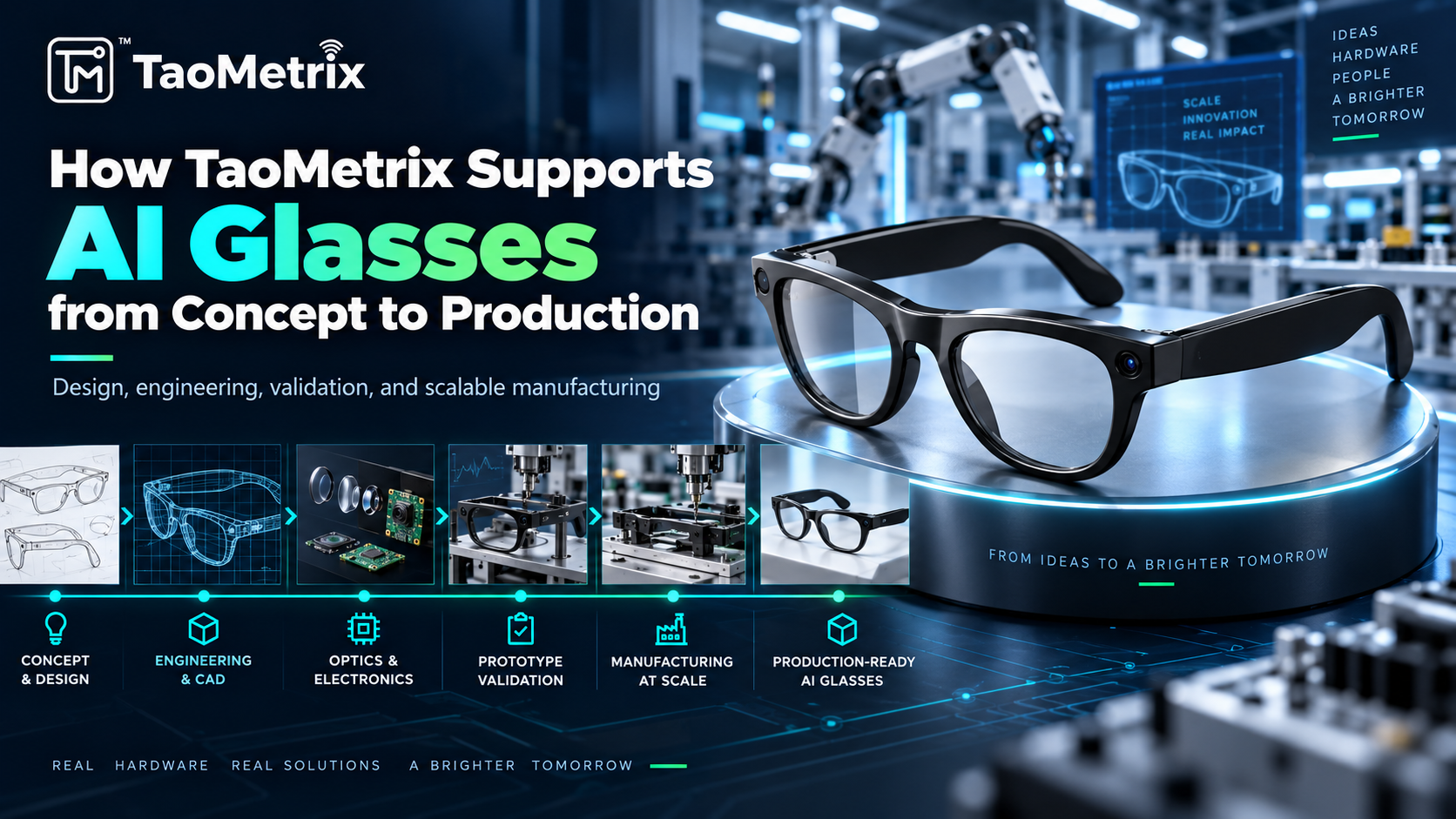
At TaoMetrix, we see AI glasses manufacturing as a systems-engineering challenge. Electronics, mechanics, acoustics, thermal design, power management, software, and production processes must be developed together.
How TaoMetrix Supports AI Glasses Projects
1. Product Definition and Feasibility Assessment
At the beginning of a project, we help clarify the product’s positioning and intended use cases.
Key questions include:
- Is the product designed for consumers or enterprise users?
- Does it require a camera?
- Does it need a display?
- Will it support real-time translation?
- Will it depend on a smartphone or cloud services?
- What are the target weight and battery-life requirements?
- Which countries and markets will it serve?
- Is the project at the concept, prototype, pilot, or production stage?
A clear product definition allows us to evaluate the hardware platform, power architecture, mechanical design, supply chain, and manufacturing risks more accurately.
2. Electronics, Mechanical, and System Integration
AI glasses require close coordination between electronics, mechanical, acoustic, and thermal engineering.
Depending on the project, TaoMetrix can support the evaluation and coordination of:
- Application processors and hardware platforms
- Cameras, microphones, and speakers
- Batteries, charging, and power management
- Bluetooth, Wi-Fi, and antenna design
- Flexible PCBA and miniaturized layouts
- Temple and frame structures
- Thermal performance and wearing comfort
- Firmware, mobile apps, and device connectivity
Our goal is to identify space, assembly, power, thermal, connectivity, and testing issues as early as possible—before the project enters pilot production.
3. Engineering Prototypes and Functional Validation
An AI glasses prototype must demonstrate more than basic power-on functionality.
Depending on the product requirements, validation may include:
- Camera image quality
- Voice wake-up and recognition
- Microphone noise performance
- Speaker volume and sound leakage
- Bluetooth and wireless connectivity
- Battery runtime
- Charging safety
- Operating temperature
- Frame and temple durability
- Firmware and app integration
- Long-term wearing comfort
These results help the product team decide whether the design is ready for the next stage instead of relying only on a technology demonstration.
4. DFM and Pilot Production
Once the design becomes more stable, TaoMetrix can support design-for-manufacturing reviews and pilot-production preparation.
We pay particular attention to:
- Ease of assembly
- Fragile wires and connectors
- Consistency of camera and microphone placement
- Compatibility between electronics and frame structures
- High-risk assembly operations
- Special fixtures and test equipment
- Critical dimensions and cosmetic standards
- The repeatability of workstation procedures
The purpose of a pilot run is to verify that the product and manufacturing process can be built consistently. It is not an assumption that mass production will succeed automatically.
TaoMetrix’s AI Glasses Manufacturing Support
TaoMetrix describes itself as an AI hardware product development and manufacturing partner. Our services cover feasibility assessment, engineering prototypes, pilot-production coordination, and OEM/ODM support.
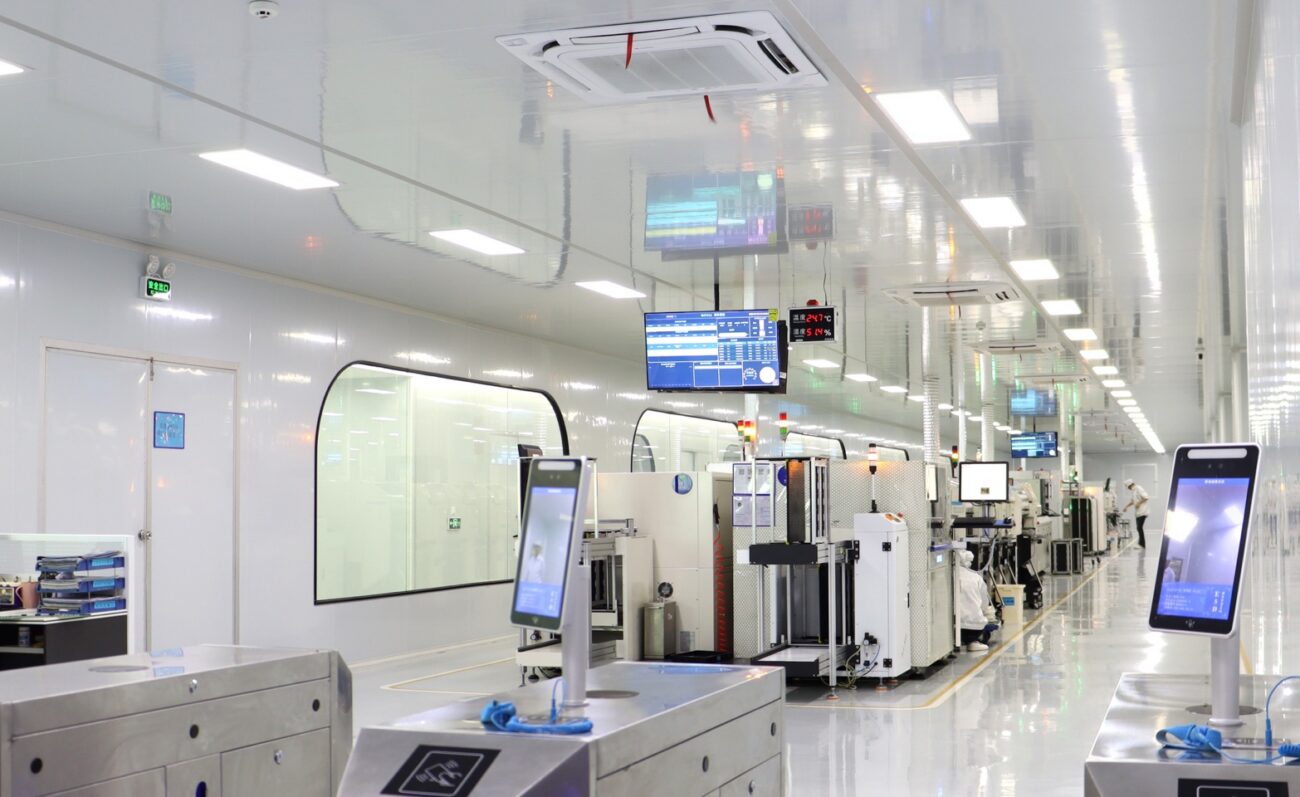
According to information published on our website, our manufacturing facility in Shajing, Bao’an District, Shenzhen covers approximately 20,000 square meters and includes:
- 12 SMT production lines
- 6 DIP assembly lines
- 4 final assembly lines
For AI glasses projects, our manufacturing support may include:
- PCB and SMT assembly
- Camera, microphone, and wireless-module integration
- Battery and charging-system assembly
- Frame, temple, and mechanical assembly
- Firmware programming and functional debugging
- Power, interface, and connectivity testing
- Appearance and assembly-quality inspection
- Engineering prototypes and pilot production
- OEM, ODM, or JDM project support
- Координация упаковки и доставки
The final manufacturing scope, pricing, lead time, and certification requirements must be evaluated against the actual product design, target volume, market, and test standards.
Why Shenzhen Is a Strong Location for AI Glasses Development
AI glasses require cooperation across multiple supply-chain categories, including:
- Optical components and lenses
- Cameras and sensors
- Chips and wireless modules
- Batteries and connectors
- Miniaturized PCBAs
- Structural components and precision assembly
- Acoustic components
- Test fixtures
- Packaging and accessories
Shenzhen offers a dense electronics, mechanical, tooling, PCBA, and consumer-hardware ecosystem. For AI glasses projects, supply-chain responsiveness, engineering communication, and pilot-production capability are all critical.
TaoMetrix aims to connect engineering, supply-chain, and manufacturing resources to reduce the gaps between product design and production execution.
What Should Customers Confirm When Choosing an AI Glasses Manufacturer?
We recommend evaluating the following areas:
- Experience with wearable electronics
- Capability in miniaturized and low-power designs
- Camera, microphone, wireless, and battery integration
- Engineering prototype and pilot-production support
- Electronic, mechanical, acoustic, and thermal design coordination
- Functional testing and cosmetic inspection procedures
- BOM, material-change, and revision control
- Confidential handling of designs, samples, and intellectual property
- Clear responsibilities for OEM, ODM, and joint-development projects
- Real validation data before mass-production approval
For AI glasses, engineering depth, testing capability, and production readiness are often more important than the initial quotation alone.
TaoMetrix’s Collaboration Models
TaoMetrix can support customers at different stages of product maturity.
OEM manufacturing
The customer provides a mature design and production package. TaoMetrix supports manufacturing, assembly, testing, and delivery.
ODM support
The customer provides the product requirements. TaoMetrix participates in platform adaptation, engineering development, and production introduction.
JDM joint development
The customer and TaoMetrix work together on electronics, mechanics, sourcing, testing, and product industrialization.
A typical project may follow this path:
- Product requirements discussion
- NDA and technical information review
- Engineering feasibility assessment
- Electronics and mechanical development
- Engineering prototype validation
- DFM and pilot-production preparation
- Small-batch pilot production
- OEM/ODM production ramp-up
The Future of AI Glasses Will Depend on More Than the AI Model
At TaoMetrix, we believe competition in AI glasses will increasingly focus on the overall user experience:
- Lower weight
- Longer battery life
- More natural voice interaction
- Better audio quality
- More reliable real-time translation
- Lower latency
- More stable phone and cloud connectivity
- More natural eyewear designs
- Stronger privacy protection
- A more mature application ecosystem
- More consistent mass production
The AI model determines what the product can understand. Hardware engineering and manufacturing determine whether the product can work reliably in everyday use.
Заключение
AI glasses are a highly interdisciplinary hardware category. They require close coordination across electronics, mechanics, acoustics, optics, batteries, wireless communication, software, and manufacturing.
TaoMetrix aims to support customers throughout this journey—from engineering review and prototype development to functional validation, pilot production, and OEM/ODM manufacturing.
If you are developing AI glasses, it is helpful to provide:
- Product positioning and target users
- Core functions
- Camera and display requirements
- Target weight and battery life
- Expected production volume
- Target sales markets
- Current project stage
- Available BOM, CAD, Gerber files, specifications, or reference samples
TaoMetrix can then assess the project’s engineering feasibility, testing requirements, and potential manufacturing path.
From AI vision to a manufacturable product, TaoMetrix helps bring smart eyewear ideas to life.